 TigerSoft News Service 8/3/2011
and Revised 5/16/2013
TigerSoft News Service 8/3/2011
and Revised 5/16/2013See also The Second Unnecessary US Depression: 1937-1938 by Wm Schmidt, Ph.D.
www.tigersoftware.com
|
TigerSoft News Service 8/3/2011
and Revised 5/16/2013 See also The Second Unnecessary US Depression: 1937-1938 by Wm Schmidt, Ph.D. www.tigersoftware.com |
Ignoring The Lessons of Keynes
and Forgetting Economic History
Put America in Needless Great Peril.
America Is Following The Same "Orthodox" Financial Policies
That Produced England's Locust Years: 1919-1937
A MASSIVE PROGRAM OF PUBLIC WORKS IS
NEEDED NOW.
(8/7/2015) DEFLATION WILL BE NO FUN. IT CAN SPIRAL INTO A
DEPRESSION.
In late 2008, the Fed acted swiftly to prevent a deflationary spiral, now they
seem hell-bent on raising rates just as Deflation is taking hold. This is very
dangerous. See http://www.tigersoftware.com/TigerBlogs/October23-2008/
http://www.tigersoftware.com/tigerblogs/obamas1937/index.html
With bad policy
choices, Deflation lasted 18 years in Britain from 1920 to 1938.
Instead we only get Austerity and the very same budget balancing
that caused England's high unemployment never to fall much
below 8% for an entire generation between 1919 and 1939. Understanding
how and why these budgetary policies kept being applied despite
their dismal failure, year after years, may help us understand
what's wrong in America now. As in England then, our politicians
here only try to please the financial community.
By William Schmidt, Ph.D.
(C) 2013-2015 All rights reserved. William Schmidt, Ph.D.
www.tigersoftware.com
www.tigersoft.com
|
This
Blog in Political Economy is brought to you by William Schmidt and www.tigersoft.com Our Tiger/Peerless Stock Market HOTLINE Called The 2011 Top. Just as in 1987, 1998, 2000, 2002, 2007 and 2008. Don't be a deer in the Hotline.  |
READ KEYNES
IN THE ORIGINAL.
INVESTORS' "ANIMAL SPIRITS":
Despite the need for new investments, if capitalists
are sufficiently frightened and expect a deep recession, they will curb their
investments
and spending AND lay off their workers and cut production.
THE "MULTIPLIER EFFECT": Each Dollar spent on Public Works has a
3-4x effect
on GNP.
TARIFFS and
PROTECTIONISM - "They
do the trick."
INEQUALITY - MARGINAL PROPENSITY TO CONSUME
Poor people spend all their money very quickly. The rich do not.
They have no need to. The Government can spur a weak economy
along much more effectively by providing jobs for working people
than giving money to rich people and expect them to spend it
or invest it, epecially if they are frightened and bearish.w, not contract.
OVER SPECULATION: BOOMS and BUSTS
"Wall Street , as
an institution ...to direct new investment into the most profitable
channels in
terms of future yield, cannot be claimed as one of the outstanding
triumphs of
laissez-faire capitalism…"
THE LESSONS OF HISTORY
UK - 1919-1937
UK's GNP fell 25% between 1918 and 1921 and did not recover from
this until 1939.
Millions were unemployed for a
generation. It Did Not Have To Be This Way.
Hoover - 1930-1932
FDR - 1937
Germany -1932
France - 1930-1932
====================================================================
IGNORING ECONOMIC HISTORY
PUTS AMERICA IN GREAT PERIL
By William Schmidt, Ph.D.
(Columbia Univ.)
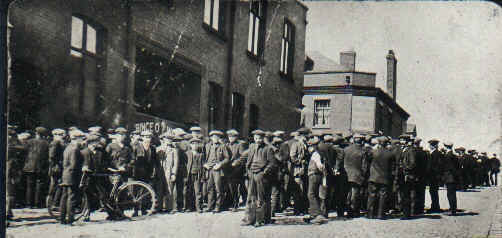
The British experience with Financial Orthodoxy should be a warning to all.
Unfortunately memories quickly fade after a generation, expecially when
the dominant elites supress the truth about how destructive their policies were.
Introduction
The story of the harm done working people in United Kingdom by the dominant
financial Orthodoxy of the 1920s and 1930s is seldom told in America. Still, I think
the main ideas that make up this Orthodoxy are easy enough to understand. Perhaps,
Americans will wake up and see what dire fate awaits them if they let their leaders
follow the very same Orthodoxy, wherein the highest priorities are always:
Unlimited Private Wealth -- Subservience to Private Financial Markets
Austerity -- Budget Balancing -- No Public Works Expenditures ,
Deflation -- A Strong National Currency
Throughout
the 1920s and 1930's, this 'orthodoxy' was also called the
"Treasury
view". The primacy of tradition and departmentalism is seen
here.
Treasury officials always advised their Chancellors, who were
nominally
their superiors, whenever the subject of Public Works came up in
Cabinet
discussions to to tell their Spending Minister colleagues, first, that Government
borrowing
money for Public Works would inevitably take away funds from
private
borrowing and thereby hurt trade and, second, the private economy was
self-correcting
and business conditions would seeon improve, so that no such
special
Public Works programs were necessary.
See
https://books.google.com/books?id=mWysZtLVQ2AC&pg=PA60&dq=stanley+baldwin+%22public+works%22&hl=en&sa=X&ved=0CEoQ6AEwCGoVChMIspmdl5-ZxwIVCUqICh1ligB8#v=onepage&q=stanley%20baldwin%20%22public%20works%22&f=false
A Recipe for Deflation
Americans
will readily recognize these dictates of Financial Orthodoxy as applied
by Presidents, Reagan, Clinton, Bush and Obama. Someone in Britain
now would
immediately see that these are still central features of Conservative
Party thinking,
especially under Margaret Thatcher and David Cameron.
Each one of the Chancellors of the Exchequer in the inter-war period were staunch
defenders of this Financial Orthodoxy. We might expect this from the Conservatives
who held sway throughout most of this period:
Austen Chamberlain (January 1919-April 1921),
Robert Horne (April 1921- October 1922),
Stanley Baldwin (October 1922- August 1923),
Neville Chamberlain (August 1923-January 1924)
Winston Churchill (November 1924-June 1929)
Neville Chamberlain (November 1931- May 1937)
But the very same policies were pursued by
Labor's Chancellor Philip Snowden (January 1924-November 1924,
June 1929-November 1931.
Some might excuse these Chancellor's ever unyielding attachment to
Financial Orthodoxy in the face of so high a rate of unemployment year
after year from 1920 to 1938, by saying that Chancellors were only doing
what was expected of them, namely:
1) fight government waste,
2) keep government expenditures within the limits of Government
revenues,
3) maintain the value of the Pound Sterling and prevent
a Weimar hyper-inflation,
4) gradually pay off the World War I indebtedness and,
5) above all, steer clear of the "event horizon" of the black hole
of Soviet-like socialism and central planning.
All these excuses pale when compared to the human cost of persistently pursuing
policies which promoted high unemployment and a stagnating capitalist economy
year after year, throughout the 1920s and 1930. Defenders of Financial Orthodoxy
in this era utterly ignored the emergence after World War I of widespread demands
that the Government properly compensate the soldiers who fought in the Great War
with decent jobs and housing. They ignore the long history of Public Works
and Council (public) Housing in the UK. And they ignore the leading
figures in the Liberal Party, like Auckland
Geddes, Alfred Mond and Christopher Addison
who advocated for a vast public works program as early as 1919, nine
years before Keynes set out a grand plan for Public Works on behalf of
the Liberal Party in 1928.
Always High Unemployment
British Unemployment in the inter-war years, 1920-1939,
never went much below 8%.
Think of the suffering, povery and the wasted potential. This did not have to
happen.
This path was chosen by the political and financial elites.
UK Unemployment UK Unemployment
US
Unemployment
Unemployed
Insured Unemployed
As a Pct. of All
as a Pct of insured
Employees
Employees
1920 2.1%
3.9%
5.8%
1921 12.2%
16.9%
16.9%
1922 10.8%
14.1%
10.9%
1923 8.9%
11.7%
4.6%
1924 7.9%
10.3%
8.0%
1925 8.6%
11.3%
5.9%
1926 9.6%
12.5%
2.8%
1927 7.4%
9.7%
5.9%
1928 8.2%
10.8%
6.4%
1929 8.0%
10.4%
4.7%
1930 12.3%
16.1%
13.0%
1931 16.4%
21.1%
23.3%
1932 17.0%
22.1%
34.0%
1933 15.4%
19.9%
35.3%
1934 12.9%
16.7%
30.6%
1935 12.0%
15.5%
28.4%
1936 10.2%
13.1%
23.9%
1937 8.5%
10.8%
20.0%
1938 10.4%
12.9%
26.4%
1939 8.5%
23.5%
Despite these dreadful numbers, year after year, the
British Chancellor of the Exchequer
and the Prime Minister always, whether they were from the Conservative or the
Labour Party, followed and preached the same financial Orthodoxy. This
Orthodoxy
was the only path to economic salvation, they always claimed.
The Conserative Mind
While High Unemployment was not the stated aim of Financial Orthodoxy, that is exactly
what its policies produced. I think it can be argued that the Conservative Party
in Britain and the "City", London's financial community, knew very well that
Orthodoxy was an excellent way to keep the workers subservient, to contol their
wage demands and to protect the rich from a successful political challenge.
If true, it means that their devotion to Orthodoxy was callous, cruel, self-serving
and based on greed. Were they biologically born without a compassion
gene? Or were the social/economic classes so separated in Britain? Certainly,
the physical separation of classes in England must have played some role.
The Cabinet Papers do not show much discussion at any time from 1921-1937
of the human costs of high unemployment. So, it was much easier to de-humanize
and disregard legitimate needs of the people one does not know. As one
English gentleman-officer in World War I famously commented: >I was quite
amazed to discover that Welsh coal miners were as "white" as I am, once the
Army washed away all their coal dust. <
Conservatives were defintely afraid a big national program of Public Works
might actually succeed. Not satisfied with criticizing Public Works as inefficient
and
unnecessary, they claimed such Government expenditures would crowd
out
legitimate private commerce and put the Government on a path toward
"Bolshevism".
They loved using this word. It stopped further thought.
When
under-paid workers rebelled by the millions in 1926 and there was a
General
Strike, this too was cakled "Bolshevism". It must be
suppressed.
No
mercy was to be shown them, said Chancellor of the Exchequer Winston Churchill.
(All
this reminds me an old IWW song.
Have
a listen - https://www.youtube.com/watch?v=eUifliF0rBU
)
Some Conservatives did think more thoroughly about Public Works. But they
never set forth a plan to reduce unemployment in this way. I suspect that they
secretly feared that such a government spending program would become very
popular and more such government programs would be demanded. After all,
the Government, had just successfully organized a massive war effort. It's
reasonable
to think, therefore, that many Conservatives at this time must have guessed the obvious:
namely, that millions would have loved a decent wage and the job security of
Government work, especially when working in private industry paid little and
was nearly always punctated by long periods of enforced idleness.
So, a much bigger but unpoken fear developed, namely: if public works
programs actually succeeded, what was the proper role for rich and for the
"City".
What would be their justification then for having so much wealth while so many
had so little. Where would bankers, stock brokers, industrialists, and
Conservative politicians position themselves in a world where the government
guaranteed everyone a decent paying job. Bankers and their rich friends
might not be needed much. Surely they would not be as important or so
well-paid.
It would be wrong to assume that Chancellors were troubled by the unemployment
and suffering they caused. The Cabinet Papers do not show they cared one whit
about the pain their policies were inflicting on millions. By going back on the
Gold Standard in 1925, Churchill immediately caused a sudden plunge in coal exports.
Miners were laid off or had their wages cut. They went on strike in strike.
The strike quickly spread. Nearly 2 million workers struck in
sympathy. (For
details.)
Churchill who was then the Chancellor of the Exchequer advocated in the Cabinets
for a full show of lethal force, including machine guns. "Either the country
will break
the General Strike, or the General Strike will break the country." He praised
the
Fascist dictator Mussolini for showing the whole world the right way to deal with
"subversive forces." The Cabinet Papers showed that Churchill wanted to
force
the miners back to work by denying their families Unemployment Relief and threatening
them with starvation. (Source.)

Tory Officer cadets were encouraged to volunteer as strike
breakers

Churchill insisted on an armed escort for a food convoy
The Minds of The
Labour Leaders
The British Labor Party's official loyalty to the Financial Orthodoxy in the
inter-war had different motivations. Realize that its leaders, MacDonald and
Snowden,
saw the Liberal Party, not the Conservative Party, as their main political enemy.
It was the Liberal Party they fought electorally most often in urban constituencies.
When the Liberal Party fully accepted and highlighted J. M. Keynes' Public Works
proposals in their official programme for the national election at the end of 1928,
Labour's leaders could not very well accept the same ideas. Keynes was a well-known
Liberal economist. Instead, they quickly proclaimed their loyalty to orthodox
Budget Balancing and the supremacy of Private Finance. They resolutely refused
to endorse public borrowing (deficit spending) to create new public jobs and
to rebuild England's infrastructure.
These two Labour leaders apparently wanted to prove to the Electorate
and to the financial Establishment that they could run the British capitalist
system better than either of the other political parties could. Were they
still socialists? Who knows. They were chosen to lead. This
was certainly
a strange position for the leaders of a Socialist Party, but MacDonald and
Snowden had reputations for independent thinking that went back to their pacifism
at the start of Worl War I. The rank and file in the Labour Party was expected
to follow their leaders, not challenge them. So, in the 1920s and until 1931,
when their leaders sought respectability and wanted to be accepted by the
financial Establishment, the rank and file accepted the Labour strategy of
first proving that they could run the country, before they would start talking
"Socialism".
Also because their Labour Party never won an outright majority in the House
of Commons, these two Labour Party's leaders in their 1924 and 1929-1931
governments, chose to follow the Orthodox Financial Policies, much like
Conservatives at the time had. They definitely did not want to give credibility
to the upstart Liberal economist Keynes.
This was even more true as the Financial Panic worsened in 1931. Seeing how
completely Private Finance froze up, they may have blamed themselves and
tried to offer the "City" even more concessions. In full crisis, the
Labour
Prime Minister MacDonald and Labour Chancellor of the Exchequer agreed
to cut the Government's budget to the point even of drastically cutting back wages
for those in Government, including even sailors in the British Navy. They also
agreed to dramatic cuts in the Unemployment Insurance benefits that millions
depended on.
I think this is proof that these two leaders themselves panicked. They could not
reverse course and admit they had been wrong. There was too much public spotlight
on them. They rightly feared the wrath of the public. So they panicked and
clung
even more tightly to the tenets of the Orthodoxy and said they had no other choice
but make severe spending cuts. This was, of course, not true. Keynes and the
Liberals had shown their were other choices. MacDonald and Snowden simply lost their
nerve. They hid behind the orthorodox Treasury view.
In the end, so upset were rank and file members of the Labour Party. that these
two "leaders" were expelled from the Labour Party in 1931. The
Labour
rank and file, however, were so disillusioned by the Labor Party Elite's subservience
between 1929 and 1931 to the "City" and Financial Orthodoxy, that they refused
to vote in large numbers for Labour until after World War II, by which time
Labour's leader Clement Atlee
had fully embraced Keynesian Public Works and
deficit spending to promote recovery and employment. In 1945, he was elected
Prime Minster by a landslide.
The Tenets of The British and American Financial Orrthodoxy
1. Balance the Budget no matter the costs.
2.
Private sector jobs are more legitimate than Public Sector.
3.
Take pride in a rising and lofty Dollar (Pound Sterling).
4.
Wall Street rules. (The "City" know best.)
5. No taxes on stock trades. No limits on executive pay.
6. Encourage Absolutely Free International Trade.
(British Conservatives did put up some tariffs on non-Empire imports.)
7.
Permit private investment capital freely to go abroad.
8. Lower prices were desirable.
The only aspect of the British orthodoxy not followed now in America was in the
area of the Bank of England's relatively high Lending Rate. The American FED, of
course,
has made the interest rate on their loans to the the biggest banks very low and has been
buying long-term mortgages in the open market. US Big Banks, it should be said,
are
the real beneficiaries of the Fed's very low interest rates loans, though home buyers
theoretically can save a lot of money buying a home, provided they can borrow the
money from a bank for a mortgage.
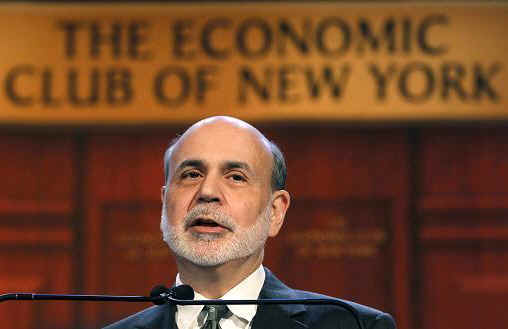
American Bankers now pay very low interest on loans from the Federal Reserve.
This seems nice, until you realize that the big banks can do whatever they want
with the cheap money. They can Buy foreign bonds, make loans to allow American
corporations to export jobs, speculate aggressively, using leverage to the fullest,
in stocks, commodities, bonds, icurrencies. They are under no obligation to
pass
along the low rates to the American Public or even make any loans. And they
can and do use this cheap money make huge campaign contributions to American
politicians to bribe them so that Wall Street always gets the inside track and
its way when policies are being made. Thus, the exception of lower interest rates
has been twisted by Wall Street to ensure its hegemony continues In America,
Main Street is of lesser importance, just as working people and small shop keepers
were when the "City" in London ruled England so absolutely in the 1920s and
1930s..
This Orthodoxy, apart from the experiment in low interest rates, is
fully supported by all Republicans. Most Democrats in Congress and the President
also uphold the American Orthodoxy. In this they are doing just what
the richest Americans and the biggest corporations want, apart from occasional
rhetorical lapses by Democrats made in the middle of their political
campaigns.
The reign of financial Orthodoxy in England had the same underlying basis:
National financial and budgetary policies always had to protect and promote
the interests of the richest Englishmen and the "City", London's financial
community, just as they saw these interests.
My hope is by seeing just how badly England was served by this Orthodoxy, we Americans
may better come to understand why we have such high unemployment still and
why the Super Rich here seem to be the biggest benefactors of the Obama Administration's
financial, banking and budgetary policies. The dire economic consequences of the
British Orthodoxy are familiar to most British economists, not just Keynesians.
In America, Government was seen as the source of economic problems by Reagan
and his followers. De-Regulation was preached for two decades by Milton Friedman
and Alan Greenspan. Clinton's Treasury Secretary, Robert Rubin, continued this
laissez-faire, conservative ideology. The pervasiveness of thieir Orthodox thinking
has prevented Americans from seeing that Keynes was not a "Red". He
believed that Capitalism in Recession could only be saved from itself if the
Government launched Public Works' programs when Private Investment failed.
Government De-Regulation is now no longer held in high esteem. Most Americans
understand that the loan policies leading to the Housing Bubble, the Bank's excessive
speculation and the fraud in selling sub-prime mortgage back securites were all
caused by a lack of government regulation. On the other hand, the great need for
Public Works is not yet widely accepted by the Political and Financial Elites in
America.
But it is growing among the people. They want decent jobs! They are tired of
waiting.
Americans understand that the American Financial Orthodoxy and "Trickle-Down"
is not working. The bull market since 2009 has not seen a comparable increase in
jobs. Rising stock prices are making the rich a lot richer. But they
corporations
are not investing in new manufacturing here. They continue to sit on billions
hidden
away in foreign tax havens. Some times the corporations use this money to buy
out a competitor But mostly, big Corporarions are replacing American
workers with new overseas factories. As costs go down, the CEOs can report higher
earnngs, make Wall Street happy and get even higher pay.
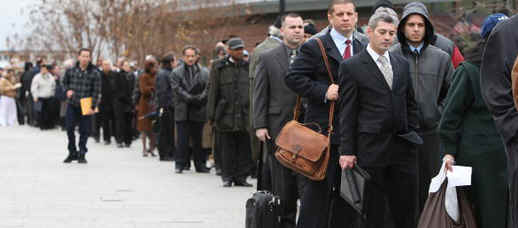
Good paying manufacturing jobs in America are too scare. The Unemployment
Rate for the unskilled is way over 12%.
Americans are told by Obama and the Democrats to be patient. "Don't rock
the boat."
"The Republicans would make things worse". "We Democrats know what
we're doing."
"The slow recovery is the fault of Republican obstructionism." Do not buy
these excuses.
If the English experience of the 1920s means anything, it means that the American
Financiol Orthodoxy will keep tens of millions of America unemployed for a decade or
tow. Almost nothing is being done by Democrats and their Wall Street backed,
free-trade, free-market Othodoxy to rapidly increase the number of decent paying
manufacturing jobs.
. Even though the dire economic consequences of Orthodoxy are becoming clearer
and clearer in America, just like the terrible, high unemployment was to people in
England in the 1920s, before evem the 1930s, the elites ignore these contradictions
almost totally. So, the political problem remains. As in England in 1926 or
1931,
what can the average American worker do? Both major political parties' leaders
support the failing policy of Orthodoxy. What will change their economic
policies?
England's experience does not make for hope. Protest marches did not work.
Even a General Strike in the UK did not work. The best hope, sadly I conclude,
would seem to be to show the Elites that even the Wealthy will better promote their
own long-term interests much better if they work to expand the domestic American
economy,
and create real jobs here, let the Government rebuiild our aging public
infrastructure and
take away Wall Street's exceptional powers.
There should be no need for so many retiring Americans to have to gamble their
savings in the stock market. Wall Street may be essential, but it should not be so
dominant.
Should not more people make things than service investors and short-term trading,
which is often parasitic and has no social value. Of course, the Big Banks
must be broken up.
They're bigger than ever. They could easily shut down the whole economy in the next
"Crash".
That they have not been broken up and there are no plans to do this shows clearly
how all-powerful the Financial Elite are politically. America is every bit as much
dominated
now by Wall Street as England was in the 1920s, when the Treasury view and the needs of
the "City" over-ruled the needs of millions who were out of work and desperately
needed
Public Works jobs since the Private Sector could not and would not provide them
year after year, after year, after year.
To seek change we must, I think, explain how and why the British political and
fnancial elites clung so stubbornly to an Orthodoxy which was clearly so destructive,
even of their own interests in the long run. It's important to see that each of the
different actors on the political stage had somewhat different reasons for refusing
to reconsider their loyalty to Orthodoxy, even in the face of the terrible Unemployment
caused by it.
As you read what I write here, keep in mind the next set of statistics. They
could very well be what is in store for America if our political and financial elites
do not shake off their ideological binkers.
British Unemployment in the inter-war years, 1920-1939, never went
much below 8%.
UK Unemployment UK Unemployment
US Unemployment
Unemployed
Insured Unemployed
As a Pct. of All
as a Pct of insured
Employees
Employees
1920 2.1%
3.9%
5.8%
1921 12.2%
16.9%
16.9%
1922 10.8%
14.1%
10.9%
1923 8.9%
11.7%
4.6%
1924 7.9%
10.3%
8.0%
1925 8.6%
11.3%
5.9%
1926 9.6%
12.5%
2.8%
1927 7.4%
9.7%
5.9%
1928 8.2%
10.8%
6.4%
1929 8.0%
10.4%
4.7%
1930 12.3%
16.1%
13.0%
1931 16.4%
21.1%
23.3%
1932 17.0%
22.1%
34.0%
1933 15.4%
19.9%
35.3%
1934 12.9%
16.7%
30.6%
1935 12.0%
15.5%
28.4%
1936 10.2%
13.1%
23.9%
1937 8.5%
10.8%
20.0%
1938 10.4%
12.9%
26.4%
1939 8.5%
23.5%
What Underlay The Tenets of Financial Orthodoxy?
The supreme concerns of this Orthodoxy were: balance the national budget, pay-off
past government debt and restore the Pound Sterling to the Gold Standard.
Deflation was welcomed, too. In all these things, the central policy makers,
the Chancellor and the Prime Minister heeded only the advice of Treasury
bureaucrats and the private bankers in London's financial community, the "City".
Orthodoxy's undeclared assumption must be noted, because of whose immediate
interests it best served. Only the private allocation of capital was
considered legitimate
in peace time. Government expenditures should be strictly limited. Borrowing
money
for Public purposes always took money away from Private investment. More jobs
could not be created by government housing or Public Works programs, because
such funds as would be used could only come from the same pool of Investment
Money that private investment drew from.
This was the financial Orthodoxy that underlay all budgetary decisions in the UK
for nearly 20 years. Its consequences grew more and more dire. In many ways,
England hibernated. Its economy stagnated. Its industrial north suffered most.
But everywhere there was high unemployment, widespread poverty, industrial
obsolescence and a decline in competiveness internationally.
Still the political and financial elites allowed no breaches or challenges to their
Orthodoxy. It was like a religious faith. The more its economic
consequences
brought economic suffering and pain, the more this was considered a positive development.
It meant society was paying off the price for some past indulgence or extravagance.
Soon,
purged of this sin, the economy would emmerge cleaner, stronger, purer and
more efficient. The champions of this financial Orthodoxy never wavered.
Their loyalty
to it was never shaken. Heretics were excluded from positions of power and
publicly scolded. Only loyal followers of the Orthodoxy became Chancellors and
Prime Ministers.
We Americans now seem doomed be victimized in the same way by our own leadership.
It repeats all the same mistakes and for the same reasons. The millions who
are unemployed are not heeded by our policy makers. The 40 million who rely
on food stamps are considered "takers" by the Republicans and never mentioned
by President Obama. Small business owners are forgotten and their stores are
replaced by big multi-national corporations wko import most of what they sell.
In this, the Republican and Democratic Party elites only hear and heed the orthodox
views of Wall Street, the Chamber of Commerce and the National Association of
Manufacturers.
As in England, it does not seem to matter how badly the Orthodoxy fails working
people. Clearly, it is making the rich much richer. And that is all that
seems to
count to Republicans. And truthfully, campaign rhetoric aside, this is also all that
matters to most Democrats in Washington, too.
Four
years after the Housing Bubble broke, American real unemployment remains
very high. Wall Street is happy, but Main Street is not. Why do our
government's
leaders, Republicans and Democrats, year after year, cry always for budget-balancing
Austerity and a Strong Dollar as their only solutions to what ails our economy?
Why do they not re-think their failed policies. When will they admit they were
wrong?
Studying the English experience shows how entrenched and self-perpetuating the
orthodox "Treasury view" was. Their political leaders could no more
abandon
their rich supporters, stop balancing national budgets on the back of working people.
or cease calling for Deflation and a much stronger national currency than ours can.
England was a Plutocracy in the inter-war years. America is a Plutocracy now.
The inter-war years in England are known as the "locust
years". The English
"roaring 1920s" were years of needless high unemployment, rusting
industry,
plant obsolescence, widespread poverty and needless suffering. There were
marches. There were demonstrations. There was even a General Strike.
Still the financial experts and elites clung to their erroneous and destructive views and
solutions. This is also the story of WHY the so-called experts and leaders,
year
after year, government after government, never changed their thinking. . ..
.
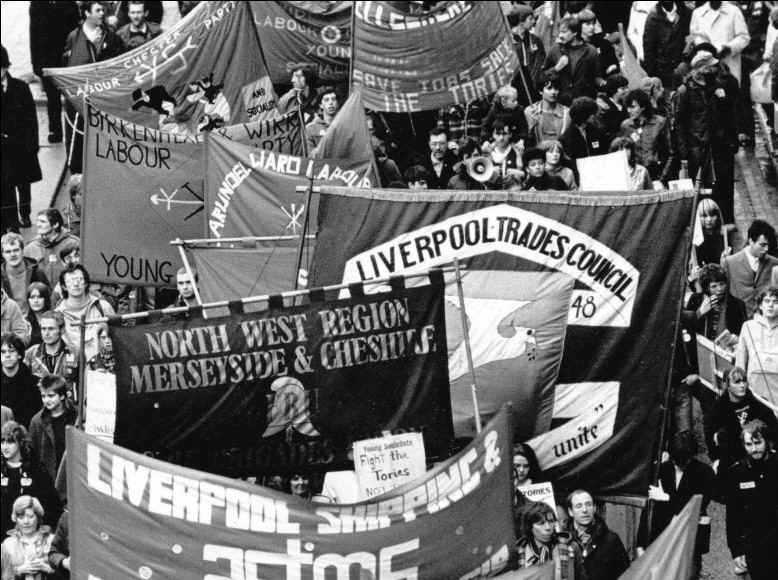
Unemployment in Britain was always very in the "roaring" 1920s.
There were even
hunger marches to London in 1922, 1923, 1927 and 1929. There were also
frequent clashes
between the unemployed and the police. (Source.)
The lowest English Unemployment fell to in the whole long period between 1921
and 1939 was 7.4%. Employment conditions were steadily poor in the 1920s
and awful in the 1930s. As in America now, "the incidence of unemployment
throughout the interwar period was generally higher for men (50% higher)...
and for older workers and youths between 21 and 25...It was particularly acute
amongst unskilled manual workers". (Source.)
From 1921 to 1939, British Unemployment was always above a million people.
In 1933 it reached 3 million. The number of hours typically worked also fell.
National unemployment rates can be compared, I think, even though methodologies
for their computation surely must have differed. The data above shows
that England's rate was much higher in 1923, 1925, 1926, 1927, 1928 and 1929
than in the 1920s. America's boom was brought about by new inventions,
cars, radios, washing machines... England's industry, in contrast, was slow to
adapt. Investments went overseas and imports were deliberately made cheaper
to allow England's financial community to enjoy the prestige of the Pound being
backed by Gold.
Orhtodox British Policy Making
Except for the post war Lloyd George government's acceptance of the principle
that the severe housing shortage in the UK should be alleviated by the subsidizing of
council houses in 1919-1920 (The Addison
Act) and the start of paying a
small amount of unemployment relief to manual workers in 1920, the economic
policies of the various British Governments from 1920 to 1939 were
always subordinate to a Financial Orthodoxy that was sometimes called the
"Treasury View".)
In this, the highest Cabinet priority was placed on Governmental Austerity and Balancing
the
Budget at all costs, no matter the levels of Unemployment. There was a strong
preference
for Limited Government. Furthermore, England was expected to strive to return to,
and then say on, the pre-war Gold Standard, even if it meant Deflation.
Free trade
was a Liberal Party and Labor Party Preference. The Conservative Governments
were mildly more protectionist.

By 1921, Conservatives accused the Ministry of Housing of high-handed
Bolshevism and the national government's role in helping to finance
council houses was rendered
almost meaningless.
In the Cabinet's many
deliberations on economic policies, always the
the financial community's interests were placed above
the needs of the average worker and the small shop keeper. In England,
the most power political exponents of this Financial Orthodoxy were
the Chancellor of the Exchequer, the Prime Minister who usually had
been a Chancellor and the Treasury Department who advised the
Chancellor and conveyed to the Chancellor the "City's"
preferences
and perspectives on "investor confidence" and the likely
success of
government borrowing.
Why
Did The British Government Pursue Only A Policy of
Financial Orthodoxy between
1921 and 1937 despite the continuing
high
level of Unemployment?
Economists typically place the blame for the stagnant inter-war British economy
on
the failure of private investment to keep up the country's infrastructure and
technology. The cotton, coal, steel and iron industries became uncompetitive
internationally. Newer industries, like cars and chemicals, grew more slowly
in
the UK than in the US or Germany.
Why did private investment fail in this?
The primary
answer: it was was not sufficently profitable to make such investments.
Interest
rates were kept high to support the Pound. Domestic demand was too strictly
limited to
buy what was already produced, primarily because so many
consumers
were poor, this a result of the high long-term unemployment.
The UK's budget
showed a surplus throughout the 1920s. Excluding interest
payments on
World War I debt, tax revenue was greater than government
spending.
By 1928, Conservatives might have asked themselves if balancing
a budget
just for the sake of balancing a budget served any good national
purpose.
They did not. The political reasons for laissez-faire were just
too strong.
In 1925, the
Pound Sterling was restored to its pre-1914 value of $4.80/Pound
by Chancellor of
The Exchequer Winston Churchill and Stanley Baldwin, the
Prime Minister.
The cost to the British economy and to the British working class
of this largely
symbolic, patriotic victory was immense.
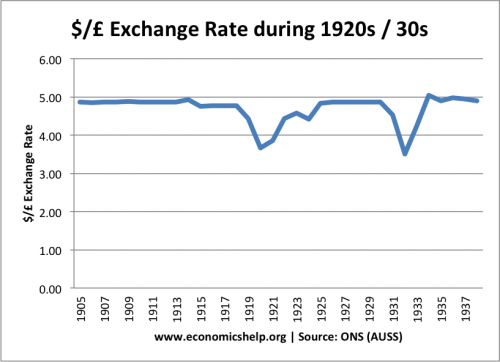
Setting the
Pound artificially high from 1926 to 1931 and from 1934 to 1939
brought
Deflation. Wholesale actually prices in Britain fell by 23%
between
1921 and 1929. Going back on the Gold Standard necessitated
high
interest rates to induce foreigners to buy British bonds. But this
made loans
more expensive and also reduced consumer borrowing.
The high
international value of the Pound ($4.80 = 1 Pound Sterling)
made it
much harder for foreigners to buy British goods. British manufactured
exports
fell while imports increased. It also became easier and much more profitable
for British
investors to take their money overseas. The wealthy, of course,
enjoyed
being able to import more foreign products. Restoring the Pound
to its
pre-War levels also made them feel that England had not lost its status
as a world
ppower. Tory nationalists like Churchill were cheered by this.
Unfortunately, the poor and the working classes lacked sufficient employment
and income
to benefit from the Deflaton.
And things
got steadily worse. The working class as a whole
steadily
lost buying power due to the high unemployment and
the way an
abundance of men seeking work tended to reduce
wages that
were paid. And without sufficient domestic buying power,
English
factories hired fewer and fewer workers. This vicious
circle
turned into a vortex in 1930.
Of course,
Conservatives in the UK, just as they do in the US now,
blamed the
introduction of unemployment benefits in 1920. These "benefits"
were so
meager, it hardly seems likely that many Englishman chose them
voluntarily over
employment.
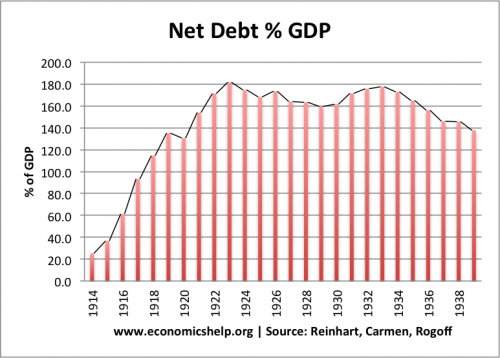
The biggest irony
of all: Years of Austerity, Budget Surpluses, the Gold
Stand and
Financial Orthodoxy did little to reduce British national debt as
a percentage of
its GDP. In 1922 the number was 180%. In 1932 it was
still 180%.
It remained little changed. Even by the Conservative's
own measuring
stick, their policies had failed. But the human costs were
huge and awful.
Look the Unemployment Percentages below. England
experienced for
17 years the same level of unemployment that Americans
have today.
Unemployment
1920 2.1%
1921 12.2%
1922 10.8%
1923 8.9%
1924 7.9%
1925 8.6%
1926 9.6%
1927 7.4%
1928 8.2%
1929 8.0%
1930 12.3%
1931 16.4%
1932 17.0%
1933 15.4%
1934 12.9%
1935 12.0%
1936 10.2%
1937 8.5%
1938 10.4%
1939 8.5%

The 1926 General Strike in Britain was called to highlight
the
continuing high unemployment and wage reductions forced on coal miners
in
the aftermath of Churchill's return to the Gold Standard.
Who Was To Blame?
I blame the governments, one after another, in this period for
failing to put
the
millions of unemployed to work rebuilding the country's rusting infrastructure
and thereby
also losing the chance to boost their buying power so that they
could buy
more British goods. This callous stubbornness doomed millions of
people in
England quite unnecessarily to long-term Unemployment, Depression
and Poverty
between 1919 and 1937.
Why were the governments so callous? Why
did they always ask what would
be the
consequences on the "City",London's financial community, but
so seldom ask why
the unemployed had to be remain unemployed so long?
The answer is
that the cold economic orthodoxy of Austerity held sway in
the
"City", in the Treasury, and in the thinking of each Prime Minister
and Chancellor of
the Exchequer. It was the dominion of this Financial
Orthodoxy among
all the political and financial elites that should be
blamed. The
same orthodoxy rules American political and financial elites
now.
America seems doomed to repeat the English experience of the 1920s
and 1930s, even more
unnecessarily than Britain did. You might think
that American
politicians might be aware of and learn something
from England's locust
years' experience. Apparently, that is asking too much.
The reasons for
America's ideological blindness and stubbornness now
seem remarkably similar
to what I learned was true in England. We should, I think,
study the British
experience closely.
This was
the subject of my Doctoral Dissertation at Columbia University.
I still
remember the rejection letter I got from Penguin. "No one will
want to
read this." Now 40 years later, it is particularly timely.
US
Policy-makers, both Republicans and Wall Street Democrats like Obama
must
somehow wake up and learn about the mistakes made year after year
by
England's top policy-makers in its dismal locust years: 1919-1937.
Stubbornly adhering to the same Financial Orthodoxy now will doom
America to
its own "locust years", with the same tragically unnecessary
consequences: high unemployment, badly neglected infrastructure,
flight of
capital abroad and poverty and poor health for tens of millions of Americans..
I have
organized the discussion below as follows:
UK - 1919-1937:
Each Chancellor of The Exchequer Demanded The Rule of Financial Orthodoxy,
despite the Continuing High Unemployment and Substantial Long-Term Poverty.
Financial Orthodoxy:
Austerity,
Budget Balancing,
Limited Government,
Going Back to Gold Standard and
Special Preeminence of the "City"(London's Financial Community)
Why Did Financial Orthodoxy Prevail?
1) The Recruitment Process for the Chancellor of the Exchequer and Prime Minister
2) The Chancellors' Political Goals Made Him More Orthodox.
3) The Treasury Department was Home to the High Priests of Orthodoxy. Why?
4) The Rich Man's Financial Orthodoxy.
Orhtodox Chancellors:
Austen Chamberlain
Robert Horne
Stanley Baldwin
Winston Churchill
Phillip Snowden
Neville Chamberlain
The Fabian Socialists' View of the Financial Orthodoxy.
Inter-War Year Challenges to the Financial Orthodoxy
1) Addison's Proposals for Health Care in 1919
2) Alfred Mond's Proposals for A Large-Scale Public Works Program in 1920
3) Keynes vs. Chruchill's Return to Gold Standard: 1914-1926
4) Liberal Party's Public Works Program: 1928
5) Keynes vs. The Treasury's Orthodoxy
6) Labor's Mosely Proposes A Massive Public Works Program: 1930-1931
7) Churchill Seeks To Dramatically Boost Spending on RAF: 1933-1936.
Keynesian Deficit Spending and Public Works
Turned down by Snowden and Neville Chamberlain: 1929-1935
Adopted by Germany and Sweden, whose economies recovered quickly.
FDR and Keynesian Deficit Spending: 1933-1936
------------------------------------------------------------------------------------
UK - 1919-1937
The theme of my 1972 dissertation at Columbia, The
Role of the Chancellor
of The Exchequer in British Cabinet Politics:
1919-1937", was quite simple.
As second in command in
the British Cabinet and heir-apparent to be
the next Prime Minister, the orthodox financial perspective and policies
of every Chancellor in this period did immense, unnecessary harm
to England and its people in its "locust years", 1919-1937. This
became clearer and clearer. Yet there was no change in their
thinking, year after year. Liberal and then Keynesian criticisms of
this financial orthodoxy were always rejected.
It cannot be said that there were no other alternatives than cutting
government spending more and more deeply to balance the national
budget. And it cannot be said accurately that these alternatives did
not get sufficient political expression to allow the Chancellors and
their defenders correctly to say that no one advised them of anything
different than the prevailing financial orthodoxy. Other solutions,
especially, massive Public Works programs and large-scale Rearmament
spending were set forth by spending ministers within the inter-war
Cabinets. Yet every Chancellor, regardless of party, year after year,
invariably fought all new government spending proposals,
no matter their merits, no matter how many
jobs they might have created,
no matter how unprepared the RAF was as Germany rearmed.
Surely, the Chancellors must have read the dismal economics news
month after month, year after year. They could see the suffering and
poverty that extended high unemployment and then Depression
brought. Yet, they all dismissed these dismal facts as inevitable
and unalterable. They chose not to see them as the direct consequences
of years and years of Austerity, Balanced Budgets and their own
"No"s to all new spending programs.
In this period, only financially orthodox policies were approved by the
British Cabinet despite 18-years of steadily high unemployment and
misery for the millions of people stuck in poverty and poor health.
The political
leadership and the political system utterly failed, much like
has now in the US. Each year it should have become clearer and clearer
that completely new financial policies were needed. Instead, the Prime Ministers
and Chancellors, year after year, stuck to the same old policies which had
always failed to bring about a real economic recovery and full employment.
Such suffering we now realize was the result of the way Prime Ministers
(who were often ex-Chancellors) and Chancellors of the Exchequer
clung stubbornly to a financial orthodoxy that still grips most politicians
in the US, the UK on in Europe. This was the Ideology of Austerity.
Its principal tenets were:
1) Always, they said, "Balance The National Budget", no matter how much
unemployment already existed, no matter how much it would be increased
by more government lay-offs and no matter how much suffering would ensue
among the poorest in society.
2) Always Protect or Enhance the National Currency. The Gold Standard
represented the natural order of things. Returning to it would bring
pre-war imperial greatness, glory and normalcy. Clearly, the reasoning here
had a big emotional component.
3) Never Challenge the Financial Community in their assessment of
how best to ensure sufficient confidence to accommodate government
borrowing needs and maximize private investment and economic growth.
If the Treasury said that the "City"'s confidence would be jeopardized
by public borrowing to finance Public Works, than that should be
the end of discussion. Always there was the danger that Public borrowing
would "crowd out" private finance.
Why did the
political leadership fail so badly?
1) The Political Recruitment
Process
The complete adherence to the Financial Orthodoxy, just laid out, by each
Chancellor of the Exchequer and each inter-war Government
came about, first, because each Conservative Prime Minister in this period
had himself been Chancellor and it was the Prime Minster, of course,
who picked who would be his own Chancellor in his Cabinet. Naturally,
these Prime Ministers picked as their Chancellor and #2 man in
the Cabinet, someone who held views and opinions like their own.
That their official residences, #10 and #11 Downing Street, were right next
to each other also reinforced like thinking.
Strikingly, except for the Labor Governments, 1924 and 1929-1931, the
man who picked the Chancellor, had himself been Chancellor and, therefore,
had himself been heavily influenced by the same recruitment process
that favored orthodoxy. In addition, the high priests of Orthodoxy in the Treasury
Department heavily influenced the thinking of the Chancellors
who became Prime Ministers as well as the current Chancellors of the
Exchequer.
2)
The Conservative Chancellor's Political Goals
Chancellors
chose financial Orthodoxy and Austerity because
they thought it served their political interests. They were already
second-in-command and heir-apparent to the office of Prime Minister.
Why, they thought, take a chance and risk becoming Prime Minister?
Why surprise or shock others, and there were many, who expected the
Chancellor to stick to an orthodox financial path.
In fact, many inter-war Chancellors did become Prime Ministers.
(Austen Chamberlain, an exception, did become the Parliamentary leader
of his party, but chose to remain loyal to Liberal Lloyd George's
government rather than seek the Prime Ministership when Conservative
back-benchers decided to break free.) Four inter-war Conservative Prime
Ministers, Bonar Law, Stanley Baldwin, Neville Chamberlain and
Winston Churchill, were each very orthodox Chancellors before they
became Prime Ministers.
Importantly, as heir apparent, the Chancellors saw no reason to give
the wherewithal to a spending minister that potentially might enable
that minister to build up such a favorable reputation on his own that it
would allow him to successfully challenge the Chancellor when it came time
for a new Prime Minister to be selected. Why help a spending minister,
up the same promotion ladder the Chancellor was on? Intra-Cabinet,
political alliances were less important to the Chancellor than keeping
the favor and trust of the Prime Minister. They knew that the Prime Minister
could ask the Chancellor to resign at any time.
Furthermore, It clearly would not help the Chancellor's chances to succeed
to the Prime Ministership if he said anything that would disturb the "City"
or weaken the Pound Sterling. So, why not continue being hard-nosed and make
a reputation as being resistant to government waste?
I believe that this deep-rooted ideology of Austerity and Orthodoxy
were promoted by the Chancellor not because the Financial
Community secretly pulled political strings, as Marxists might allege.
The Financial Community did not have to pull any strings or make
make big campaign contributions, as in America, There was no such need.
All the Chancellors were already their natural allies. The Chancellors shared
the same thinking and fully appreciated the political advantages of adhering
to the financial orthodoxy. They were already on the fast track
to become
Prime Minister provided they did not do something foolish and provided they
did not allow a spending ministers to gain a grander reputation that would
threaten their own. .
Their adherence to the prevailing financial orthodoxy was thus a matter
of political convenience. Chancellors in this period opposed all increases
in government spending. Exceptions I could not find. They did not pick
and chose some new spending proposals to reject and some to
accept. When they were over-ruled in the Cabinet, they formally dissented.
They believed that encouraging any one spending proposal would
encourage others. And they said this quite openly. In this way there
was no need to think hard and develop a subtle, layered, nuanced
view of national finance and macroeconomics. Rather, they could claim
to be maintaining the grand tradition of the Treasury and the Chancellor.
Chancellors of the Exchequer were not part of a hidden financial cabal
Their Orhtodox views and loyalties were openly expressed. And it served
their political goals to work hard to reinforce, rather than challenge,
the Financial Orthodoxy in the mind of the Public and the Press.
A complete acceptance of the tenets of Austerity and Orthodoxy were
viewed by the Chancellor as the best way to keep the financial community
happiest and to avoid financial panics. Interestingly, Snowden the
Labour Chancellor was as devout a believer of Austerity and Financial
Orthodoxy as any of the Conservative Chancellors. We will look at his
case closely further below.
Orthodoxy was expected of Chancellors in the secret and private Cabinet
discussions of public policy and finance. Orthodoxy is what they delivered
behind the scenes. One might think that given the secret nature of Cabinet
deliberations (This is the so-called "collective responsibility"), they
might have voiced a heterodox view now and then. I could find
no instances of this in all the Cabinet memoranda and minutes I read
at the Public Records office in London.
It was as though they turned off their "free will" and their ability to do
critical thinking. All the inter-war Chancellors played this orthodox role
in exactly the same way. The arguments a Chancellor used against spending
proposals to build Council Houses in 1920, to launch a Public Works program
in 1920 or 1930, or to expand and modernize the RAF (Royal Air Force) in 1934
were always the same. Such expenditures would cost too much. The budget
could not afford them. They would cause a bigger budget deficit. In
turn, this
would jeopardize investor confidence, hurt the Pound (and the stock market)
and drive up the costs of borrowing from home and abroad. At best, such
spending proposals were "ill-timed". Usually, they were considered
"wasteful",
"dangerous if they encouraged others to also seek new spending" and
"damaging to investor confidence".
3) The
Treasury Was Home to The High Priests of Financial Orthodoxy.
.
The Chancellor depended upon the Treasury's civil servants to advise
him and give him the arguments and numbers that he used in the
Cabinet papers and discussion, as well as in his speeches in Parliament,
including his annual presentation of the Government's budget. It was
much easier to get the Treasury to do what it had always done, namely
demonstrate how a budget must be balanced, than to get it to
advance arguments in favor or public borrowing that would break
with its traditions. None of the Chancellors I studied questioned the
traditional, orthodox view that each year the national budget must always
be balanced.
The Chancellor with Cabinet approval could seek or modify taxation,
but with one exception, he never challenged the Treasury's position
on how much revenue might be raised by different taxes and through
government borrowing. The Treasury's views and recommendations
seem always to have been accepted. They were never challenged.
The only exception, perhaps, was Chancellor Bonar Law in 1915, when
he proposed that the Government issue War Bonds with a lower
interest rate than the Treasury advised. Law claimed correctly that
an appeal to patriotism would be successful.
Why
were the Treasury civil servants so orthodox in their thinking?
Wikopedia says Treasury orthodoxy
was the view that fiscal policy
has no effect on the total amount of economic activity. In his 1929
budget speech, Winston Churchill said the
"The orthodox Treasury view ... is that when the Government borrow[s]
in the money market it becomes a new competitor with industry and
engrosses to itself resources which would otherwise have been employed
by private enterprise, and in the process raises the rent of money to all
who have need of it."
Chicago's
Milton Friedman agreed with the Treasury view. He helped make
Libertarian economics popular in the 1980s and 1990s. The Crash of
2008 now shows just how fatally flawed this orthodoxy is..
Rebuttal is easy. In the first place, the Government could instruct
the Bank of England to print a lot more money, which the government
would borrow and then spend on Public Works. The pool of money
to be borrowed could thereby be made much bigger.
But let's assume there was no new printing of money. The Treasury
orthodoxy falsely assumed that the private sector borrowed in order
to invest the money immediately in the UK and that employment readily
followed. Only by making this assumption, could they assume
that private sector borrowing would be exactly as effective in boosting
employment. Yet, clearly relying on private investment failed to
create enough jobs for nearly two decades in England.
Showing its own bias, and how completely its collective thinking was
captured by the ideology of the promoters of financial capitalism, the
Treasury managed to assume that private investors would use
borrowed money at least as constructively as the Government would,
That it would help create jobs in the UK, that such private investments
would rebuilding the infrastructure as needed, that it would bring about
innovation and a modernization of the manufacturing base and otherwise
that it would make more of the things that working people needed.
This was clearly not true and did not happen. A lot of the borrowed
money in this era went overseas. This was encouraged by the artificial
pegging of the Pound to the Gold Standard. Some of the borrowed
money also went to rich Englishmen who bought yachts, took around-
the-world trips or purchased homes on the Riviera. A lot of the borrowed
money allowed British brokerages and banks to speculate in stocks.
Certainly, there is little evidence to make us believe that private investments
boosted employment as much as planned public works would have.
Even more telling problems arose for the Orthodoxy when the speculative
bubble in shares broke and the economy turned down. In a deflationary
period, there is every incentive for rich people to borrow money and then
just to sit on it, waiting for lower prices to deploy it. In the severe Depression
of the 1930s, the private sector lost its nerve completely. Private investment
was paralyzed. It largely stopped altogether. Left to sort itself out, there is
no telling how long the Depression would have lasted. The private sector
froze up in panic and chose to wait for someone else to boost the economy
and start buying things again. Private borrowing for plant modernization
stopped completely.
,What was the government to do, just wait around until the private sector
got their nerve back? This inter-war era and our own experience in 2010-2011
show how readily corporations in panic mode choose to hoard rather than
spend their savings, though some may buy out competitors when their
shares have fallen far enough. Banks also enter a panic mode. They refuse
loans to even reliable and good customers. So the "velocity" of money flow
may in these bad times slow down to close to zero and unemployment
sky-rockets up and falls only very slowly, as inventories of necessities
must be replaced. By contrast, when massive Public Works jobs were
launched, as they were by FDR in 1934-1936, thousands and thousands
of workers gained badly needed employment. And they, unlike rich
people, spent almost 100% of their new income immediately. The benefits
did not stop there to the economy. The money spent in this public employment
meant immediate income for shop-keepers in poorer areas. As their inventories
started finally to go down, the would buy more inventory and even
hire new help themselves.
These points seem simple enough. The real question is why
did the Treasury side with the rich against the unemployed poor?
When Churchill
wanted political arguments to make on behalf of
Laissez-faire, Austerity, Balanced Budgets and Going back on the
Gold Standard, the Treasury was happy to comply and produce
a lengthy series of "rebuttals" to Keynesian arguments on behalf
of the 1928 Liberal Public Works' investments' Plan.
Why?
First, and foremost, Orthodoxy was their "meal ticket". The
Treasury
enjoyed their special financial position. In trying to refute Keynes,
they fought to maintain their authority and prestige. They wanted to
pretend and believe that only they were masters of the arcane complexities
of national finance. After all, they knew the sum of all the spending
departments' demands on the Treasury. They liked to pretend that
only they, among civil servants, could argue from a national viewpoint
and responsibly match government spending with government revenue..
They enjoyed their authority vis-a-vis other departments. They were the
ones most responsible for preventing wasteful spending. They could
get and challenge the spending of any other department.
There is another answer to the question of why they clung to their orthodoxy
in the face of so much evidence in the Unemployment numbers
that their preferred policies were failing the country. This was TRADITION.
It was always easier for Treasury civil servants to do what they had always done.
Using the long familiar techniques to measure Spending and Revenue
was a lot easier than developing new measures of Marginal Consumption,
Marginal Investment, Hoarding, Money Flow, Capital Outflow or the Multiplier.
There is another reason why the Treasury was home to Financial Orthodoxy
in the British civil service. Years of close relations with the London
Financial community took their toll on independent thinking. The Treasury
depended on stock and bond brokers to carry out the government's
financing needs. They got many of their numbers from the big banks
of the times. "Public" finance was completely dependent on the
"City";
The Bank of England did not print more money in bad times.
Always, it was the Treasury that articulated the "City's" views
on changing events to the Chancellor.
Treasury officials seem to have accepted with no debate or question
the City's preference for keeping the Pound as strong strong as possible,
The City naturally wanted London to remain the dominant international
financial center of the era. They wanted the Pound back on the Gold
Standard, so it would be widely used as an international currency, thereby
attracting
foreign capital to and making bigger profits for London's
key
banks and brokerages. It was the Treasury, on behalf of the"City"
that persuaded Churchill as Chancellor to return to the Gold Standard
in 1925.
Lastly, the simple answer is that Treasury bureaucrats, like any groups
of government workers is apt to do, sought security. Why draw attention
to themselves by doing anything unconventional? Why risk demotion or
dismissal. There was nothing to be gained by challenging the Orthodoxies
of Austerity, Budget Balancing, the Gold Standard and the Supremacy
of Private Finance and the "City". Reading the Treasury's rebuttals
of
Keynesian Public Work proposals in 1929-1931 makes it clear that all
the higher Treasury officials, namely the ones who wrote the official papers
the Chancellor circulated in the Cabinet and the ones who communicated
regularly with the Chancellors, fully accepted the prevailing Orthodoxy.
Implicit or explicit in everything they wrote or said was that the national
budget had to be balanced. Otherwise, the financial trust needed for the
government to continue to borrow successfully from rich people would
be jeopardized. Under no circumstances except in war-time, should
the government's borrowing needed be allowed to threaten the private
investment market or the London financial community in the "City".
community.
4)
The Rich Man's Perspective
Rich people bought most of the government's bonds. They
paid most of the taxes that the government ran on. The Conservative
Political Party leadership in the 1920s and 1930s were all very well-off.
To understand why Austerity, Balanced Budgets , Limited Government
and the Gold Standard always dominated the Chancellors perspectives
and policies, we have to consider what I call the "Rich Man's Perspective."
Why court disaster with new economic policies? I'm rich. I don't
want my savings to deteriorate in value? I want it to appreciate in value.
I want my loans paid back in money that is more dear than when I loaned it?
By all means, return to the Gold Standard. I want my expensive
imports to be cheaper. And if the Pound goes up, will not my Shares
on the Bourse also rise? And what's this about more public employment?
All my friends at the Club agree, they are lazy and drunken incompetents.
The only honest work is private work. Worse, why should we let the people
see that the government can provide council houses cheaper than
our private builders can make? Soon, workers will want public
health care? They'll want the trains to be run by the government?
They'll
start thinking that there need not be millions who are unemployed
for years and years, at a time? What if they realize that we wealthy
people are really good job creators, at all? Keep workers dependent
on us employers. We'll take care of them. We don't need government
to tell us how to run our factories or stores.
The Socialists'
Perspective
The Treasury's view was not accepted by rank and file members of the
Labor Party. They had a more Marxist view of "financial
orthodoxy",
budget balancing and protecting the Pound Sterling at all costs.
They saw the private interests' resistance to government spending
to build public housing, better railroads, new parks, schools and
libraries, etc. as class warfare. Public works were very badly needed
after World War I. Millions of returning soldiers were looking for
jobs. Why they wondered the jobless put to work building houses?
Why did orthodox financial thinking reject such obvious solutions to
social needs?
Both revolutionary and Fabian socialists considered the government's
policies to protect the financial community at all costs as proof that the
government was controlled by rich and powerful capitalists, especially
those in high finance. Marx had taught that capitalists seeking higher
profits inevitably try to drive wages down. They are actually
quite
pleased when high unemployment causes real wages to fall. And
such was exactly the experience of England's large working class.
There can be little doubt that the capitalist upper class had always
been afraid that the masses would use greater economic security,
such as Keynesian public works programs would provide, to organize
workers for higher wages. This the financial community and the
business community knew full well would threaten their political power
as well as their profits.
Even more fearful for the well-to-do, was that the masses would
see that Government actually could do a fine job in many areas
of the economy. Health care. Schools. Housing. Transportation.
BBC.
This was very dangerous for the rich. Once the lower class majority
saw that the rich were dispensable and that private interests seeking
profits hurt the general welfare, depriving ordinary people of much
needed goods and services, more and more sectors of the economy
might be nationalized and run as public charters. Private interests would
then no longer be able to compete. Weakened, the special influence of
the rich would gradually shrink until it was not significant. This was
the Fabian view of Sydney and Beatrice Webbs and George Barnard Shaw
who founded the London School of Economics.
In their view socialism could come about peacefully through small,
discrete changes. Sadly, we realize now, the Webbs seriously
underestimated how fiercely the wealthy would fight even piecemeal
growth of government services and how the career interests of Chancellors
of the Exchequer would sustain the failing status quo. Fabians also
did not understand how entrenched orthordoxies like "balanced budgets",
"austerity" and a strong Pound Sterling were in the Treasury bureaucracy
and civil service. If only to keep themselves on a status above bureaucrats
in other spending ministries, these orthodoxies fit the needs of the Treasury staff.
They delighted in thinking themselves as the Elite among civil servants in the UK.
What better way to promote the status and importance of the Treasury
and its staff in all intra-governmental relationships, than enshrine as Gospel
the Orthodoxy of Budget Balancing No Matter The Cost. This way even
moderate sized expenditures elsewhere had to be approved by the Treasury.
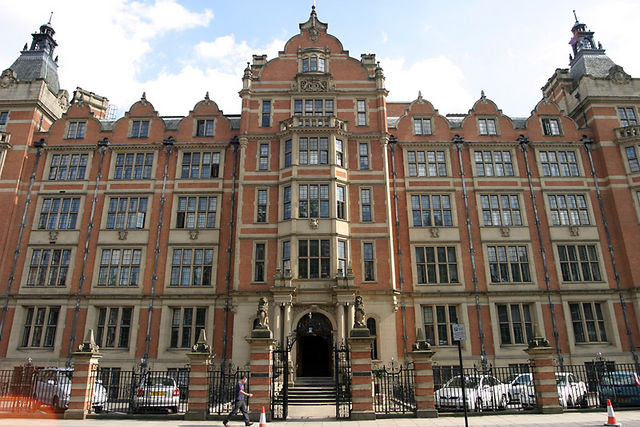
London School of
Economics was founded by Fabians.
Chancellors of The Exchequer: 1919-1937
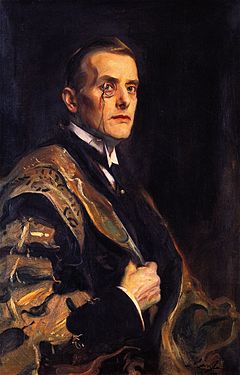
Conservative Austen Chamberlain, brother of Neville Chamberlain.
Chancellor of the Exchequer: 1918-1921 and then Conservative
Party Leader.
Following the victory of the Lloyd George coalition in the elections of 1918,
Austen Chamberlain was appointed to the position of Chancellor of the
Exchequer in January 1919. In his view, his major task was to return
war time government spending to more normal levels. He fervently
resisted efforts within the Cabinet by Liberal spending ministers
to put returning veterans to work building public housing and
hospitals. Government
spending was cut by 75% from 1918 to
1920.
Austen Chamberlain served as Chancellor until 1921 when he rose to
the pre-eminent position of Leader of Conservatives in the
House of Commons. Bonar Law, himself a Chancellor during
the war, stepped down for reasons of health. It appeared that
Austen Chamberlain was in position to become the next Prime Minister.
Lesser known Robert Horne became Chancellor for a few months.
But Chamberlain's loyalty to the Liberal Prime Minister, Lloyd George,
cost him politically among Conservative MPs. Because of the rules
of Cabinet Secrecy, they had no way of knowing how fiercely
Chamberlain had fought Liberal spending ministers. "In the autumn
of 1922, Chamberlain faced a backbench revolt (largely led by Stanley
Baldwin)
designed to oust Lloyd George, and when he summoned a
meeting of Conservative
MPs ...a motion was passed in favor of
fighting the forthcoming election as an independent party. Chamberlain
resigned the party leadership ...and was succeeded by a revived Bonar Law.
In the aftermath of the back benchers's revolt, Bonar Law formed a
new government and Chamberlain was not offered a position. Instead,
Stanley Baldwin was made the new Chancellor in recognition of his
role in endin g the Lloyd George national government.

Robert Horne, who was Chancellor between 1921 and 1922,
refused work in Bonar Law's new Cabinet in a lesser role.
Two years later, he also refused to be Minister of Labour in
Baldwin's government, preferring private work in the "City"
in the area of foreign investments.

Stanley Baldwin was Chancellor of The Exchequer, 1922-1923,
in the Bonar Law Conservative Government. He was Prime Minister
between 1923-1929 and 1935-1937. In 1923 he served as Prime Minister
and Chancellor of the Exchequer.
Baldwin's career points to how positions with the Treasury served as
among the best political posts to step up from to become Prime Minister.
His relationship as Chancellor to the spending ministers was typical,
apart from his efforts to get the rich to voluntarily pay more to the Government
based on a patriotic appeal during World War I and his promotion of
tariffs while Chancellor and later as the new Prime Minister. He imbibed
the standard Treasury financial orthodoxy not just as Chancellor but
as Financial Secretary to the Treasury.
Baldwin's Background
"After receiving a third-class degree in history at
Cambridge, he went into
the family business of iron manufacturing... Baldwin proved to be very adept
as a businessman, and acquired a reputation as a modernizing industrialist.
Later he inherited £200,000 and a directorship of the Great
Western Railway
upon the death of his father in 1908...During the First World War he
became Parliamentary Private Secretary to
Conservative leader
Andrew Bonar Law...
In 1917 he was appointed to the junior ministerial post of
Financial Secretary to the Treasury where he sought
to encourage
voluntary donations by the rich in order to repay the United Kingdom's
war debt...He personally donated one fifth of his fortune...in the form of
£120,000 of war loan stock to the Treasury.[3
In late 1922 dissatisfaction
was steadily growing within the Conservative Party over its coalition
with the Liberal David
Lloyd George. At a meeting of Conservative
MPs
at the Carlton
Club in October, Baldwin announced that he would no longer
support the coalition and famously condemned Lloyd George for being a
"dynamic force" that was bringing destruction across politics. The meeting
chose to leave the coalition, against the wishes of most of the party leadership.
As a result Bonar Law, the new Conservative leader,
was forced to search
for new ministers for his Cabinet and so promoted Baldwin to the position
of Chancellor of the Exchequer. In the November 1922 general election
the Conservatives were returned with a majority in their own right. Bonar
Law resigned in January 1923 and Baldwin succeeded him, serving
as
Prime Minister and until August 1923, as Chancellor.
1923
was a year of falling prices and rising unemployment. The Bank of England
paid
no heed to these Deflationary signs. They sought to prepare the way for
the
return of the Pound Sterling to the Gold Standard so that the City of
London
could again become the center of international finance. With the
Chancellor
of the Exchquer's (Stanley Baldwin) approval, they raised the
base
interest rate from 3% to 4%. In July 1923, Keynes publicly condemned the
the
City's "narrow" interest in this, saying such a deflationary policy
would
soon prove to be a "horrible" mistake. Liberal Party Lloyd George
went
further and called for a large scheme of Public Works. (Source.)
Neither
the Conservatives nor the Labour Party Leadership seriously
considered
such a plan. Baldwin, Neville Chamberlian (the new Chancellor
in
August 1923) and then Phillip Snowden, the next Chancellor in 1924
dismissed
an expansionary program of massive Public Works quite
of
hand. (Source.)
Snowden claimed Lloyd George had made false
proposals
like this at the end of the Great War and nothing had come
of
it when he was Prime Minister.
Baldwin
appointed Winston Churchill as Chancellor in January 1924.

Churchill's Admits His Biggest Mistake
Churchill said that the biggest mistake of his long political career was trying in 1924
to push up the Pound by putting it back on the Gold Standard in the middle of an
economic slow-down and trying then to cut government spending to balance
the budget. He claimed he wanted Britain to return to pre-war conditions.
The actual result was deflation, higher unemployment, and a miners' strike
that led to the General Strike of 1926.
Interestingly, Churchill was advised by
Keynes not to take England back to the Gold Standard, but chose to
accept the advise of a former Chancellor of the Exchequer, Robert McKenna,
(1915-1916).
"The return to the pre-war exchange rate
and to the Gold Standard depressed
(British) industries. The most affected was the coal industry. Already suffering
from declining output as shipping switched to oil, as basic British industries
like cotton came under more competition in export markets, the return to the
pre-war exchange was estimated to add up to 10% in costs to the industry."
See http://en.wikipedia.org/wiki/Winston_Churchill
With Unemployment above 8%, the ex-Chancellor, now Prime Minister,
Stanley Baldwin, fell back onto slogans like "Safety First" and "Trust
Baldwin"
rather than produce any new policy to reduce unemployment. Churchill
must have sensed that his policies had contributed to the weak economy
in 1928. He sought better justification from the Treasury for his policies
to ward off the Liberal Party call for a massive public works program.
It took 25 years, but Churchill did to his credit, come to see his mistakes
as Chancellor and to appreciate that an the economist JM Keynes
had been correct. At the time, JM Keynes, penned in the "Consequences
of Mr. Churchill" (1926). In it he warned that taking England back on
the Gold Standard would add deflation to the already high unemployment
and that would certainly cause a Depression. Keynes was exactly right.
A Depression followed three years later.
Public Works Advocates in British Cabinet, 1919-1930
Even before Keynes, Liberals had advocated Public Works to reduce
unemployment. Prime Minister Asquith's 1909 Development Plan did
this. It was not just the more radical members of the Labour Party
that saw what a dead-end laissez-faire capitalism. Several members
the
Coalition Cabinet in 1919 and 1920 advocated greatly expanded
Public
Works tp ensire fuller national employment, most notably:
Auckland Geddes,
1919-1920(Conservative - Unionist)
See http://filestore.nationalarchives.gov.uk/pdfs/small/cab-24-75-gt-19-6880.pdf
Dr. Chistopher Addison
1919-1920, (Liberal)
Alfred Mond
(Liberal) in 1920 founder of Imperial Chemical Industries),
ex-Prime
Minister Lloyd George starting in 1923 and
Labour
Party maverick Oswald Mosely in 1930.
Mosely put forth a
memorandum
in January 1930, calling for the public control of imports and
banking
as well as an increase in pensions to boost spending power.
John Meynard Keynes
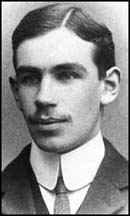
In July 1923, Keynes lambasted the Baldwin government and the Bank of
England for raising the base interest rate from 3% to 4% and then 5%,
despite the high unemployment. They did this to shore up the Pound and
make it easier to go back on the Gold Standard. Keynes wrote in the Nation:
"The Bank of England acting under the influence of a narrow and
obsolete doctrine has made a great mistake." In November 1923,
Keynes published A Tract on Monetary Reform. He called the
Gold Standard "a barbarous relic". Devaluation was much more
preferable than deflation.
In May 1924, when British Unemployment reached 1 million, he called
for a massive government program of Public Works. Keynes explained
that the chronic high unemployment in the 920s was caused by
inadequate private investment. He claimed that deficit spending by the
government could make up for this and reduce unemployment.
Meanwhile, speculators who expected Britain to return to the Gold Standard,
were busy driving up the value of the Pound. This made imports easy.
It encouraged saving and speculation. It discouraged exports and
investments in industrial production and hiring.
On April 29, 1925, Chancellor of the Exchequer, Winston Churchill, accepted
the advise of his economic advisers at the Treasury and Bank of England.
Britain officially returned Sterling to the Gold Standard.
Between 1925 and 1926, British coal exports plummeted. Mine owners
cut the mine owners pay. A general strike in support of the miners
occurred in May 1926.
May 10, 1930, Keynes
wrote in the Nation:
"The fact is - a fact not yet
recognized by the great public -
that we are now in the depths of a very severe international slump,
a slump which will take its place in history amongst the most acute
ever experienced. It will require not merely passive movements of
bank rates to lift us out of a depression of this order, but a very active
and determined policy."
December 1930 Keynes
publishes A Treatise on Money.
in it, he distinguishes between Investment and Saving.
If Investment exceeds Saving, there will be inflation Keynes says.
If Saving exceeds Investment there will be recession.
Thus, in the midst of an economic depression, the government's
correct course of action should be to encourage spending and
discourage saving.
see http://www.maynardkeynes.org/keynes-career-timeline.html
At that time, he did not mention such concepts as "the multiplier effect",
"marginal
consumption" or the "liquidity trap", which were only incorporated into his
larger
macro-economic analysis in 1936.
Keynes' seminal "The General Theory of Employment, Interest and Money" (1936)
grew out of his many years of confrontation with the economic orthodoxy
of the British Treasury. Keynes knew the Treasury and its orthodox fiscal
thinking all too well. He had worked there in WWI. In fact, he was one of
Lloyd George's key economic advisors at the Paris Peace Conference of 1919.
He totally disagreed with the harsh terms placed on Germany. He predicted
disastrous economic and political consequences would follow. Germany's
hyper-inflation in 1923 was a direct consequence of the Carthaginian reparations
demanded of Weimar Germany for the Kaiser's Imperial German war. Keynes
willingness to challenge orthodox thinking must have been boost mightly
by how exactly hist predictions were borne out. It is often said by wiping out
Germany's middle class, it was much easier for the Nazis to rise to power
and for Jewish politicians and bankers to be blamed by the extreme right
in Germany. In college, Yale, we had to read Keynes
The Economic Consequences
of the Peace (1919)
It was a superb lesson in how prescient someone can be and yet still not
be listened to by the establishment, by policy makers or by the public.
In early 1929, Keynes wrote much of the Liberal Party's manifesto on the
desirability of Public Works. Amazingly, the Labour Party would have no
part of this program. Perhaps, many felt there was no way to reform Capitalism.
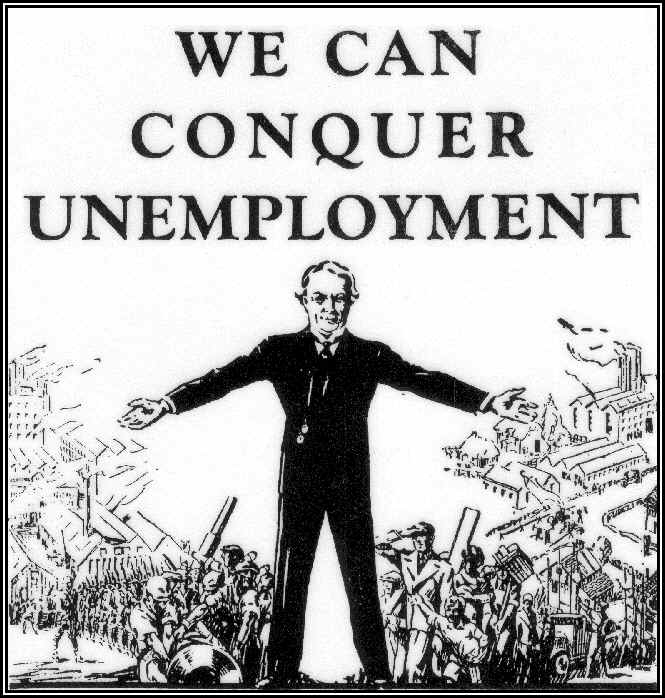 Ex PM Lloyd George, March 1, 1929 "If the nation entrusts the Liberal Party at the next General Election with the responsibilities of Government, we are ready with schemes of work which we can put immediately into operation, work of a kind which is not merely useful in itself but essential to the well-being of the nation. The work put in hand will reduce the terrible figures of the workless in the course of a single year to normal proportions, and will, when completed, enrich the nation and equip it for competing successfully with all its rivals in the business of the world. These Plans will not add one penny to national or local taxation. It will require a great and sustained effort to redeem this pledge, but some of us sitting at this table have succeeded in putting through even greater and more difficult tasks in the interests of the nation." Extract from Mr. Lloyd George's address to Liberal Candidates on 1st March, 1929. WE CAN CONQUER UNEMPLOYMENT "THE word written to-day on the hearts of British people, and graven on their minds is Unemployment. For eight years, more than a million British workers, able and eager to work, have been denied the opportunity. At the end of 1928 the total reached a million and a half; a quarter of a million more than a year before. These workers with their dependents, represent four or five million souls. They are a very nation, denied the opportunity to earn their daily bread, condemned to hardship, to wearing anxiety and often to physical and mental demoralisation. What a tragedy of human suffering; what a waste of fine resources; what a bankruptcy of statesmanship! This is by far the biggest single issue before the country. All parties will claim to have a solution, It is the task of the electors to decide which solution is the most likely to achieve success. In making a decision, they must consider not only the superficial attractiveness of the various proposals, but the extent to which they are based on sound reasoning and patient enquiry, and will be backed by driving power and by experience. This is a brief outline of the proposals of the Liberal Party. They have been developed as the result of enquiries of the most exhaustive character, lasting over years; indeed, even political opponents have paid tribute to the thoroughness and the ability put into the work of investigation. |

In 1929, Keynes himself made numerous speeches mocking the balance-the-budget
Treasury bureaucrats and the City's orthodoxy above all else.. He showed that
putting a man to work would make needed improvements to the country's
infrastructure and would only cost the government half of what it paid him,
because the Treasury was already paying him an unemployment "dole".
Keynes
Described but Did Not Quantify The Multiplier
Effect"
The new employee, he argued, would spend all his money, as would the
merchants that he then made purchases from, thus producing a chain of
additional economic activity which would boost country's economy. This was
to become the famous "multiplier effect". Other economist like R.F.Kagan
took this concept and first quantified it in 1931.
As merchants' profits rose again, so would the revenue the to the national
Treasury. That would, in turn, boost business confidence and interest rates
would not go up, as the Treasury's pundits warned. For details see
http://www.personal.kent.edu/~edechena/1929%20Multiplier%20Arithmetic%20by%20Keynes%204-06.pdf
Keynes was not advocating socialism or
central planning. He simply wanted to
find ways to restore full employment and business confidence when, left to
laissez-faire alone, all he could see was economic stagnation, poor housing,
high unemployment and a worsening public infrastructure. Britain's locust years,
1919-1938, increasingly sound like America after 2009.
BUDGET BALANCING MADE
THINGS
MUCH WORSE UNDER LABOUR PARTY.
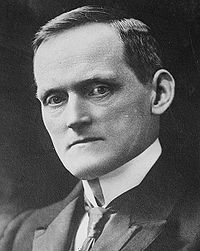
Philip Smowden, Labour's Chancellor of the Exchequer, 1924 and 1929-1931.
Clement Atlee who served in the Labour Cabinet with Snowden and later became
Prime Minister after World War II, wrote the Snowden was a "docile disciple of
orthodox finance". "I had not thought him (Snowden) capable of such
virulent
hatred" for and "betrayal" of those in the rank and file of the Labour
Party.
See As It Happened (1954).
Sadly, Phillip
Snowden, Labour's Chancellor from 1929-1931, bought
"hook, line
and sinker" the anti-Keynesian orthodoxy put out by Treasury officials,
the Bank of England and the "City" (London's financial community.
He reduced taxes on some popular items but allowed no new public
works programs to pass. He later claimed he could not do so because
Labour was a minority government that survived by getting Liberal
votes in the House of Commons and the Liberals would not permit
deficit spending.
His September 1931 Budget severely cut public spending and public sector
wages while raising income taxes on average workers from 22.5% to 25%.
It also reduced unemployment benefits by 10%. Snowden had wanted
a 20% cut. He warned that balancing
the budget was the only way to
restore confidence in sterling; that if
his recommendations were not
accepted, sterling would collapse and
"if sterling went the
whole international financial structure
would collapse, and there would be no comparison
between the present depression and the chaos and
ruin that would face us."
These brutal measures utterly failed to do any good. They made the lives
of many poor working people much more miserable. Unemployment
actually rose to 3,000,000. There was a Mutiny in the Royal Navy.
And despite all the austerity measures, there was still a run on the
Pound and in Britain was forced leave the Gold Standard in panic mode.
As a consequence, the Pound Fell 25% and world wide stock markets
collapsed. .
http://en.wikipedia.org/wiki/Great_Depression_in_the_United_Kingdom
They also led directly to the fall of the Labour Government. Several
ministers refused the cuts in benefits and resigned. The Prime Minister
and then formed a new national government with Conservative
and Liberal ministers. Neville Chamberlain, was soon to become the new
Chancellor of the Exchequer. He had previously called for further government
cuts and no new taxation on the wealthy. Meanwhile, both Snowden and
MacDonald were expelled from the Labour Party.
Why did the Labour
Chancellor support Austerity?
It cannot be said that Snowden sought to his increase his popularity
within the Labour Party by adhering to the same financial Orthodoxy
that Conservative Chancellors did. This made him immensely
unpopular. So, why did he accept its dictates so completely?
He and MacDonald, as the Labour Party leaders first to come to power
in the UK, apparently wanted to prove that they were worthy of the trust
of their "betters" when they were called to form a government.
(Doesn't this sound like President Obama's subservience to the big
banks?)
An additional reason why these Labor leaders refused to embrace
a massive scheme of public works was that they did not want
to bring credit to the Liberal Party, their main political opponents in
many working class constituencies. Unlike Snowden and MacDonald,
Lloyd George and the Liberals had listened to Keynes call for public works
and deliberate deficit spending to increase Consumption and reduce
the chronic high unemployment.
Exchequer Chancellor, Philip Snowden, was formerly a
passionate
Christian Socialist. In his autobiography, he
proudly proclaimed
he had never read anything Karl Marx had written. He did not
believe in a general strike by labor. He believed moral appeals
would gradually bring about a more just, socialist society. He had
no "clue" what to do about the Depression as Chancellor. He is
alleged to have said in office in 1930: "No one told us what to do".
Snowden seems to have been prone to public dissembling. Within the
British Cabinet, he fought harder than anyone else against Public Works
expenditures and measures to ease the burden on the unemployed.
What surprised me as I did my dissertation's research at the Public
Records Office in London and read the previously sealed and secret
Cabinet Papers was that Snowden used the very same language as each
of the other Conservative Chancellors of the 1920s. There was no
difference. He denounced new spending proposals because they
would further unbalance the national budget and worsen confidence
in the Pound.
He piously called for the nation to spend only what it could presently
afford, implying just like Republicans in America in 2011. that past
profligate spending was to blame for the crisis of finance. Never in
any of his Cabinet memoranda, which were then circulated to other
ministers in the MacDonald Government, did he ever question the
financial advise given him by his Treasury advisers and the London
Financial establishment. Perhaps, he was afraid to ask what exactly
would be the consequence of a decline in Sterling, for fear that simply
asking the question would make it seem that Devaluation was
being actively considered. This is the explanation he gave in his
memoirs. But why did he not even ask such questions as:
"Would not some British exports be increased by a
weakened Pound? Who would benefit? Who would lose?
"Would not the unemployed who might be provided new
government jobs boost Labour Party voting?
"Would not their new public employment reduce government
expenditures by getting them off the 'Dole'?
"And would not their spending help the economic condition
of local grocers, the cobblers and the dry goods' haberdashers?"
As I say, there is no evidence that Snowden ever asked any of
these questions of the Treasury civil servants under his command.
My judgment us that he did not have enough understanding of
his responsibilities as Chancellor to ask such questions. Worse,
he even seems to have taken a perverse delight in telling his Labour
colleagues that they were not privy to the information and the
superior understanding he had about public finance. They were quite
wrong, he lectured them as school children, to ask the government to
break tradition at such a dangerous time of financial crisis, deliberately
unbalance the budget and launch a massive scheme of Public Works,
as the Liberal Party had proposed in its 1928 Platform. His air of
superiority in this matter as he spoke in Commons grated upon
Labout back-benchers.
"In February 1931, Philip Snowden made a speech in the House which
created a sensation. He hinted at large economy measures, including cuts
in the social services and unemployment benefit, in order to balance the coming
Budget and maintain the gold standard. Meanwhile wholesale prices continued
to fall on a world scale, businesses were losing money in some cases and making
very little in others, so that revenue from taxes was declining. A big budget deficit
was foreseen. In this debate I remember Lloyd George spoke and referred
to the Chancellor sitting on ice surrounded by 'the penguins of the City'.
Having received Snowden's speech with stony silence, we on the Labour
benches roundly cheered Lloyd George.
"The next day there was a meeting of the Parliamentary Labour Party. Snowden
soundly rated us like naughty schoolboys for having done this. I remember many
of us, including myself, replied that we would applaud anyone who talked sense,
but we did not get that from some of our leaders."
Morgan
Philips Price, My Three Revolutions (1969)
His obstructionism was politically disastrous. The Labour
Government fell and did poorly in subsequent elections. Many
rank and file Labour supporters became discouraged and
turned away from the Party. Many probably reasoned: "What
was the point of voting Labour?".
Out of office, Snowden continued to defend the Treasury
view that there was no way to pay for massive public works programs.
He called such talk "Bolshevism run mad". For this he was knighted.
Snowden was expelled from the Labor Party. As Viscount Snowden,"
he was in political limbo until 1937. In that year, he must have taken
the the time to actually read Keynes. With colossal disingenuousness,
he bitterly blamed the Labour Prime Minister for not launching a
Public Works program.
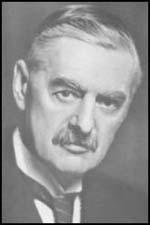
Neville Chamberlain, Chancellor of the Exchequer, 1931-1937.
Prime Minister, 1937-1940.
Year after year, as Chancellor in the MacDonald National Government
and then the Baldwin Conservative Government, Neville Chamberlain
fought against boosting military expenditures, especially for the RAF,
as proposed by Churchill, who was then back in the Cabinet as
a spending minister. This was Chamberlain's doing.
"His
biographer, Andrew J. Crozier, has argued: "He proved a powerful
chancellor of the exchequer. Baldwin, who as leader of the Conservatives
was happy to leave formal power in the hands of MacDonald, left the
substance of power in Chamberlain's hands. From the beginning Chamberlain
was in complete control of budgetary and economic policy and added to that
social and industrial policy as well. Furthermore, once the international crisis
of the 1930s deepened, he became a dominant voice in both rearmament and
foreign policy. His was a formidable presence in the cabinet: not only did he
read his own departmental briefs, but he seemed to read everyone else's as well."
On 8th March 1935 Chamberlain wrote in his diary: "I am more and more
carrying this government on my back. The P.M. (MacDonald) is ill and tired,
S. B. (Stanley Baldwin) is tired and won't apply his mind to problems. It is
certainly time there was a change".
http://www.spartacus.schoolnet.co.uk/PRchamberlain.htm
It is said that Chamberlain changed course in 1936 and backed
such spending. The Cabinet Papers that I read in doing my
dissertation show exactly the opposite. Again, Cabinet Secrecy
and the doctrine of Collective Responsibility make it hard for
outsiders to know what positions individual ministers took in
internal cabinet debates. I was fortunate to be advised by
Benjamin Schwatrz at the London School of Economics to
go over to the nearby Public Records Office, as the inter-war
Cabinet Papers had suddenly been opened up. The 50 years'
official secrecy rule was changed to 30 years in 1966.
Some of the Cabinet papers are now available on the internet.
https://discovery.nationalarchives.gov.uk/SearchUI/register?returnUrl=%2FSearchUI%2FDetails%3Furi%3DD7653854
|
See Treasury Responses to Keynes: 1925-1946 http://books.google.com/books?id=mWysZtLVQ2AC&pg=PA114&lpg=PA114&dq=ramsay+macdonald+keynes&source=bl&ots=O8-DYuqmm0&sig=idgXTtOOBDBZUuIts-PFPRFPXyg&hl=ru&sa=X&ei=hEyIUa3bMIHOiwKEx4HYCg&ved=0CE8Q6AEwBA#v=onepage&q=ramsay%20macdonald%20keynes&f=false Much of what is quoted below comes from http://www.spartacus.schoolnet.co.uk/TUkeynes.htm Keynes' Advocacy of Public Works Was Ignored by Policy-Makers In 1925 John Maynard Keynes
married the ballerina, Lydia
Lopokova, and moved to Tilton, a farmhouse near Firle in East Sussex. The marriage proved a
great success and when apart they wrote every day. The couple
had no children.Other members of the Bloomsbury Group, including Virgina Woolf, Leonard Woolf, Vanessa Bell, Clive Bell, and Duncan Grant also lived in
the area. Keynes became increasingly interested in what he called "the management of the economy". According to Alec Cairncross:
"Two forms of economic instability preoccupied him. Of these the first was
instability of prices, inflation, deflation, and all that went with them; the second was
unemployment and the fluctuations in economic activity giving rise to it. The two were, of
course, interconnected since the movement of prices reacted on the level of activity: but
the analytical approach to the problem of inflation, for example, was very different from
the analysis necessary for an explanation of unemployment." During this period he was a member of the Liberal Party and worked closely with its leader, David Lloyd George. In 1929 Lloyd George published a pamphlet, We Can Conquer Unemployment, where he proposed a government scheme where 350,000 men were to be employed on road-building, 60,000 on housing, 60,000 on telephone development and 62,000 on electrical development. The cost would be £250 million, and the money would be raised by loan. Keynes also published a pamphlet supporting Lloyd George's scheme. These views impressed Richard Tawney who wrote a letter to Ramsay MacDonald, the leader of the Labour Party, about the forthcoming election: "If the Labour Election Programme is to be of any use it must have something concrete and definite about unemployment... What is required is a definite statement that (a) Labour Government will initiate productive work on a larger scale, and will raise a loan for the purpose. (b) That it will maintain from national funds all men not absorbed in such work." MacDonald refused to be persuaded by Tawney's ideas and rejected the idea that unemployment could be cured by public works. In the 1929 General Election the Conservatives won 8,664,000 votes, the Labour Party 8,360,000 and the Liberals 5,300,000. However, the bias of the system worked in Labour's favour, and in the House of Commons the party won 287 seats, the Conservatives 261 and the Liberals 59. MacDonald became Prime Minister again, but as before, he still had to rely on the support of the Liberals to hold onto power. The election of the Labour Government coincided with an economic depression and Ramsay MacDonald was faced with the problem of growing unemployment. In January 1929, 1,433,000 people were out of work, a year later it reached 1,533,000. By March 1930, the figure was 1,731,000. In June it reached 1,946,000 and by the end of the year it reached a staggering 2,725,000. That month MacDonald invited a group of economists, including John Maynard Keynes, J. A. Hobson, George Douglas Cole and Walter Layton, to discuss this problem. In March 1931 Ramsay MacDonald asked Sir George May, to form a committee to look into Britain's economic problems. The committee included two members that had been nominated from the three main political parties. At the same time, John Maynard Keynes, the chairman of the Economic Advisory Council, published his report on the causes and remedies for the depression. This included an increase in public spending and by curtailing British investment overseas. Philip Snowden rejected these ideas and this was followed by the resignation of Charles Trevelyan, the Minister of Education. "For some time I have realised that I am very much out of sympathy with the general method of Government policy. In the present disastrous condition of trade it seems to me that the crisis requires big Socialist measures. We ought to be demonstrating to the country the alternatives to economy and protection. Our value as a Government today should be to make people realise that Socialism is that alternative." When the May Committee produced its report in July, 1931, it forecast a huge budget deficit of £120 million and recommended that the government should reduce its expenditure by £97,000,000, including a £67,000,000 cut in unemployment benefits. The two Labour Party nominees on the committee, Arthur Pugh and Charles Latham, refused to endorse the report. As David W. Howell has pointed out: "A committee majority of actuaries, accountants, and bankers produced a report urging drastic economies; Latham and Pugh wrote a minority report that largely reflected the thinking of the TUC and its research department. Although they accepted the majority's contentious estimate of the budget deficit as £120 million and endorsed some economies, they considered the underlying economic difficulties not to be the result of excessive public expenditure, but of post-war deflation, the return to the gold standard, and the fall in world prices. An equitable solution should include taxation of holders of fixed-interest securities who had benefited from the fall in prices." The cabinet decided to form a committee consisting of Ramsay MacDonald, Philip Snowden, Arthur Henderson, Jimmy Thomas and William Graham to consider the report. On 5th August, John Maynard Keynes wrote to MacDonald, describing the May Report as "the most foolish document I ever had the misfortune to read." He argued that the committee's recommendations clearly represented "an effort to make the existing deflation effective by bringing incomes down to the level of prices" and if adopted in isolation, they would result in "a most gross perversion of social justice". Keynes suggested that the best way to deal with the crisis was to leave the gold standard and devalue sterling. Two days later, Sir Ernest Harvey, the deputy governor of the Bank of England, wrote to Snowden to say that in the last four weeks the Bank had lost more than £60 million in gold and foreign exchange, in defending sterling. He added that there was almost no foreign exchange left. Philip Snowden presented his recommendations to the MacDonald Committee that included the plan to raise approximately £90 million from increased taxation and to cut expenditure by £99 million. £67 million was to come from unemployment insurance, £12 million from education and the rest from the armed services, roads and a variety of smaller programmes. Arthur Henderson and William Graham rejected the idea of the proposed cut in unemployment benefit and the meeting ended without any decisions being made. The cabinet met on 19th August but they were unable to agree on Snowden's proposals. He warned that balancing the budget was the only way to restore confidence in sterling. Snowden argued that if his recommendations were not accepted, sterling would collapse. He added "that if sterling went the whole international financial structure would collapse, and there would be no comparison between the present depression and the chaos and ruin that would face us." The following day MacDonald and Snowden had a private meeting with Neville Chamberlain, Samuel Hoare, Herbert Samuel and Donald MacLean to discuss the plans to cut government expenditure. Chamberlain argued against the increase in taxation and called for further cuts in unemployment benefit. MacDonald also had meetings with trade union leaders, including Walter Citrine and Ernest Bevin. They made it clear they would resist any attempts to put "new burdens on the unemployed". At another meeting of the Cabinet on 20th August, Arthur Henderson argued that rather do what the bankers wanted, Labour should had over responsibility to the Conservatives and Liberals and leave office as a united party. According to Malcolm MacDonald, the opposition to the cuts in public expenditure was led by Henderson, Albert Alexander and William Graham. MacDonald went to see George V about the economic crisis on 23rd August. He warned the King that several Cabinet ministers were likely to resign if he tried to cut unemployment benefit. After another Cabinet meeting where no agreement about how to deal with the economic crisis could be achieved, Ramsay MacDonald went to Buckingham Palace to resign. Sir Clive Wigram, the King's private secretary, later recalled that George V "impressed upon the Prime Minister that he was the only man to lead the country through the crisis and hoped that he would reconsider the situation." At a meeting with Stanley Baldwin, Neville Chamberlain and Herbert Samuel MacDonald told them that if he joined a National Government it "meant his death warrant". According to Chamberlain he said "he would be a ridiculous figure unable to command support and would bring odium on us as well as himself." On 24th August 1931 MacDonald returned to the palace and told the King that he had the Cabinet's resignation in his pocket. The King replied that he hoped that MacDonald "would help in the formation of a National Government." He added that by "remaining at his post, his position and reputation would be much more enhanced than if he surrendered the Government of the country at such a crisis." Eventually, he agreed to form a National Government. John Maynard Keynes was extremely active in his campaign to encourage the government to
take more responsibility for running the economy. In 1931 he agreed an amalgamation of the
Nation with the New Statesman, a
journal owned by the Fabian
Society. Keynes now became a regular contributor to what was now Britain's leading
intellectual weekly. |
Hoover - 1930-1932
Much too late, towards the end of his life,
President Hoover rued following the
lassez-faire advise of Andrew Mellon, his Treasury Secretary, as they
dealt with
the gathering Depression. Tragically, Hoover ran a Federal Budget surplus in
1930
and engaged only in paltry increases (under $257 million / year) in federal
government
spending in 1930 and 1931, just when private investment and government revenue
were collapsing. 1932 did see a big increase in government spending, but
the next year Hoover's budget again reduced government spending, despite
national unemployment levels of 25%.
Tea Party types champion Keynes critics like Freidrich Heyek. They seem not
to understand that Hayek was essentially, a hands-off liquidationist. Hayek argued
it was "difficult to see what lasting good effects can come from credit expansion.
The
thing which is most needed to secure healthy conditions is the most speedy and complete
adaptation possible of the structure of production.If the proportion as determined by the
voluntary decisions of individuals is distorted by the creation of artificial demand
resources [are] again led into a wrong direction and a definite and lasting adjustment is
again postponed.The only way permanently to 'mobilise' all available resources is,
thereforeto leave it to time to effect a permanent cure by the slow process of adapting
the structure of production." http://www.j-bradford-delong.net/tceh/slouch_crash14.html
Keynesianism -1936
The economist JM Keynes in 1936 wrote that in a
panic, the government must
intervene directly to create jobs with public works' programs. In that way, the
booms
and busts of a capitalist, market driven economy could be greatly reduced.
He warned of the "liquidity
trap", when monetary policy is unable to stimulate much
of an econoimic recovery. (Sounds very contemporary, doesn't it?)
A Depression, Keynes showed, is self-perpetuating and self-accelerating, in
large part
because the working class has so little money and cannot buy what is produced.
The wealthy, of course still have money. But the savings of the rich do not always
translate automatically into investments and jobs. In a panic and recession, there
is just too much fear.
He introduced the term, the "multiplier effect" and made much of how the
"rates of
marginal consumption" vary enormously according to where the Government
spends its money and on whom. Bribing officials in Afghanistan has very few,
if any downstream economic benefits in the US . Paying a poor person to dig
ditches in a depression has a high multiplier effect. Each additional dollar of income
for the poor person is immediately spent. The recipient of the money this spent,
then has monet to spend and so on.. On the other hand, the rich person may just
save his extra dollar and put it into a bank that is too scared to make loans.
Accordingly, Keynes reasoned that the best way out of the Depression would be
for the government to hire the unemployed in massive Public Works programs.
he people hired would spend 100% of their money and this would stimulate
business, such that a Dollar in public works' wages would bring three to four
dollars in new buying. The additional business produced by a massive public
works program would restore confidence and unfreeze spending and private
investment. In the end, Government Revenues would rise much more than the
initial government expenditures.
Wikpoedia writes: "In the 1930s,
Keynes spearheaded a revolution in economic
thinking, overturning the older ideas of neoclassical
economics that held that free
markets would in the short to medium term automatically provide
full employment,
as
long as workers were flexible in their wage demands. Keynes instead argued that
aggregate
demand determined the overall level of economic activity, and that
inadequate aggregate demand could lead to prolonged periods of high
unemployment.
Following the outbreak of World War II, Keynes's ideas concerning economic policy
were adopted by leading Western economies. During the 1950s and 1960s, the success
of Keynesian economics resulted in almost all capitalist governments adopting its
policy recommendations,..."
http://en.wikipedia.org/wiki/John_Maynard_Keynes
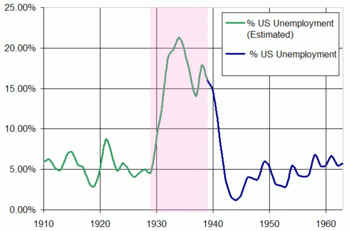
Keynes is often over-simplified, the better to tear
him apart. He did not believe
in hiring men to dig a ditch and others to fill it in. Carefully planned public
works
repair the nation's infrastructure and provide badly needed jobs. Who now
challenges the benefits of TVA or Boulder Dam?
Supplyside economics is not Keynesian. Cutting taxes to grow the economy
and ultimately to increase federal revenues works well if it induces investors
to create and expand US enterprises. But if it only serves to increase speculation
in Gold and Commodities, make other countries' economies grow at the
expense of American jobs or lets millionaires take more excursions abroad,
then there is no "trickle down". Keynes did not believe that tax breaks
for
investors would build schools.
FDR - 1937
Keynesian thinking was not widely accepted in 1932.
FDR even campaigned
in 1932 that he would balance the budget. Fortunately, once in office his
federal budget decocts were much bigger than Hoover's. As the stock
market roared back from 50 to 170, between 1933 and 1937, his Treasury
Secretary put the fear of "over-speculation" and "inflation" in FDR's
ear.
Despite the warnings from his Brain Trust, who were familiar by then with
Keynesianism, FDR in the spring of 1937 decided to get southern Democrat
support for his policies by announcing new spending cut backs and a desire
to balance the budget despite the unemployment of 14%. This meant drastic
reductions of WPA and other New Deal jobs' and public works' programs.
The fragile economic recovery immediately stalled out, the stock market fell 47%
in six months and unemployment rose sharply.
To his credit, FDR in early 1938 saw his mistake and no longer sought to
balance the budget in the middle of the Depression.
See http://www.tigersoftware.com/TigerBlogs/Obamas1937/index.html
The Federal Budget
and The Unemployment Rate: 1929-1945
       Tax       Federal    GNP       Unemp.
Year   Receipts  Spending   Growth    Rate
-------------------------------------------------
1929      --       --         --      3.2%  < Hoover era, Great Depression begins
1930     4.2%     3.4%     - 9.4%     8.7
1931     3.7      4.3      - 8.5     15.9
1932     2.9      7.0      -13.4     23.6
1933     3.5      8.1      - 2.1     24.9   < FDR, New Deal begins; contraction ends March
1934     4.9     10.8      + 7.7     21.7
1935     5.3      9.3      + 8.1     20.1
1936     5.1     10.6      +14.1     16.9
1937     6.2      8.7      + 5.0     14.3   < recession begins, May
1938     7.7      7.8      - 4.5     19.0   < recession ends, June
1939     7.2     10.4      + 7.9     17.2
1940     6.9      9.9
1941     7.7     12.1
1942    10.3     24.8
1943    13.7     44.8
1944    21.7     45.3
1945    21.3     43.7
          (Source: http://www.huppi.com/kangaroo/Timeline.htm )


                        Germany - 1929-1932
             Successive German Chancellors tried to balance the budget as the recession got
                     worse by cutting government expenditures.  This increased unemployment and
                     lowered still further government revenues, thereby causing a new political crisis,
                     which brought in a new Chancellor who followed the same policy of cutting government
                     spending.  In 1932, Hitler rose to power in large part because of the failure of
                     the moderate parties to adopt a pragmatic Keynesian approach.  His policies
                     put Germans back to work by the millions, most notably by building the Autobahn
                     and massively rearming.
          http://histclo.com/essay/war/ww2/tol/ger/seiz/ger-dep.html

             Chancellor Hermann Muller (1928-1930) headed a very broad and unweildy
                     coalition of his own Social Democrats, Centre Partyand the nationalist German
                     Peoples' Party.

             Brüning (1930-1932) as chancellor said he wished to free Germany from
                      Reparartions, but would have to tighten credit, raise taxes, reduce government
                      spending and roll back wage increases.   Working people were hit the hardest.
                      His policies only served to increase the popularity and Reichstag voting strength
                      of the Nazis and Communists.
France - 1930-1935
Keynes
counter-cyclical fiscal writings were not translated int French until 1942.
The Third French Republic featured a parliamentary system of government with
a high degree of political fragmentation. Coalition governments were inherently
unstable and had no power to boldly provide government employment or
taxation of the rich. This increased discontent, bred more extremeism and
hurt business confidence further.
|
From http://en.wikipedia.org/wiki/Great_Depression_in_France
France The distress of the population had political consequences. A riot on 6 February 1934 led to the fall of the government and a nation which had traditionally leaned to the right elected the socialist Popular Front government in 1936. The Popular Front, an alliance of Socialists and Radicals with support outside the government of the Communists, was led by Léon Blum. The Popular Front introduced many measures such as the 40-hour working week and holidays with pay, but Blum felt handicapped in introducing more than limited changes to the economy because of his dependence on the more right-wing Radicals. This did little to placate a population anxious for change and a wave of strikes broke involving two million workers [9] Factories were occupied and membership of the Communist party rose to 300,000 in 1937. In the night of 7–8 June 1936, employers and unions signed the Matignon agreement by which they raised wages by seven to 15 per cent to increase workers' buying power, to stimulate the economy and to bring an end to the strikes. Blum brought in measures to control cereal prices, to insist that the Banque de France place the national interest above that of the shareholders, and nationalised the armaments industry. That upset the Left, which saw too much legislation, and did nothing to please the Right, which believed that state involvement in a capitalist economy would bring about disaster. The Radicals would not accept currency controls and the result of the unrest was that capital fled abroad. That weakened the economy and employers tried to minimise the results of the Matignon agreement, which created more social tension and in turn a further flight of capital. Devaluation of the franc by 30 per cent became inevitable, despite government assurances that it would not happen. In January 1937, Blum went further and announced "a pause" to social reforms. The Senate refused to give him emergency powers to cope with the recession and he resigned on 20 June 1937 and the first Popular Front began to fall apart. A second had even less success. The President, Lebrun, called on the Radical leader Édouard Daladier to form a new government without the Socialists. Daladier relied on liberal economics to rescue, or at any rate keep afloat the economy on a worldwide sea of financial difficulties. Employers and police acted harshly against strikers and determined to root out "troublemakers". In 1938 the Senate gave Daladier the emergency powers that Blum had been denied and the government favoured employers over workers in industrial disputes, particularly in companies which had come close to coming under the control of their workers.[10] |
Sweden - 1935
"Sweden's quick recovery was astonishing.
By 1934, real output had
recovered to 1929 levels. By 1935, it was 7 percent above it. Growth would
continue well into World War II. Sweden's success owed everything to its liberal
government. In 1932, Labor returned to power. The Swedish Finance Minister was
heavily influenced by a group of economists led by Gunnar Myrdal, who had been
advocating Keynesian-like solutions for years. The Labor government promptly
ran large deficits, and within two years had spent itself out of the Depression. "
http://www.huppi.com/kangaroo/Sweden.htm
Keynes' Multiplier Now Is Smaller.
America's Manufacturing Base Needs Restoration
In the 1930's international trade was not nearly so important
as now. Cheap
imports
were not so plentiful as today, when if a worker is hired to help build,
say, a public high speed transit system with federal governent money, he might
well spend some of his stimulus-paycheck at Target, Walmart or Home Depot,
where so many things are imported, especially from China. In this, the Public
Works'
expenditures boost the Chinese economy, and to that amount, less the American
economy,
What's
worse, if the steel to be used for the cars and rails is not American made,
the multiplier drops some more. In fact, the US Federal Government is very lax
compared to other industrialized countries when it comes to requiring special
efforts
first be taken to buy American. Again the Keynesian multiplier is reduced
in
our times, compared to the 1930s.
Another
factor that reduces the Multiplier, is that some of those hired in this
Public
Works project would very likely have been hired by a private employer
somewhere
else in, say, 3, 6 or 12 months. To consider this worker's employment
to be completely due to public infrastructure expenditures, one would have to
have the Public Works project heavily employ the unskilled and untrained. In
fact,
"creaming" of the of the unemployment pool would be quite common. To
the extent,
that this is so, the multiplier is made smaller and GNP does not grow so fast as one
might hope because of these projects..
Obama's modest 2009 stimulus, used "shovel-ready projects" which State
and Local Governments were intending anyway to undertake in the not too distant
future. Obama's stimulus did have the positive effect in these cases of
speeding up the expenditures and hiring. But it is less clear that it helped
employ the less skilled and untrained or made any dent in the problem of the
long-term unemployed. At least half of the current unemployed have been so for
more than 6 months.
Wars and military bases are hugely expensive. Literally, trillions are spent
overseas where there is relatively little secondary or tertiary benefits to the US
economy. Private contractors like Blackwater and Halliburton have even become
foreign based. From the view point of increasing jobs and GNP, it would be hugely
beneficary to shift from Military Spending to Public Works. The
financing of a
massive public works program might slightly serve to increase interest rates.
But since 1/2 of all Federal Expenditures is for the military, any conceivable
shift of priorities and spending on Public Works would not be much of a threat
to the bond market or inflation, except perhaps locally where skilled workers'
wages might go up. And if the Dollar were actually weakened, because of more
public sector spending, it would serve to reduce imports of manufactured goods
and increase their exports fromt he US. Presently, the slack in the
economy is too
great to cause any chance of wage inflation.
From
this, it is clear that if Obama really wanted to increase US employment
and help the economy the best way, he would act quickly to prevent the flight of
investment capital overseas. He should impose tariffs and rethink all those trade
agreements that have allowed foreign imports to supplant domestic manufacture.
KEYNES SWITCHED TO PROTECTIONISM
WHY WON'T OBAMA?
In 1932, Keynes
told a Parliamentary committee that "The thing about tariffs is -
they do the trick" . He grew
to consider tariffs to be vital to smooth the economic
cycle and provide greater employment through government intervention.
( See - http://www.jstor.org/pss/2120714
) Keynes considered tariffs to be necessary
where the government sought to maintain its currency and at the same time
increase employment at a time when wages were falling.
His Favorite Solution
"(D)omestic investment could be
indirectly subsidized to increase domestic output and
reduce foreign lending. Keynes called this "my own favourite remedy," which
could be
accomplished by a tax on foreign bonds, by changes in the banking system to increase
domestic lending, or even by direct capital expenditures by the government."
http://www.go2cio.com/articles/index.php?id=3668
OBAMA - 2011
Mr. President, Community Colleges Are Not The
Problem
Obama naively asserts that American workers don't have the skills
to compete.
That is not the problem. It is how easily corporations can locate overseas
where wages and safety conditions are much lower. In this, he is the mouthpiece
of the free traders on Wall Street, who are only interested in coroporate profits,
not in American workers or even American consumers.
Obama will not release his college transcripts. So,
maybe he did study
history and economics at some point. What is clear, is he shows NO awareness
whatsoever of these economic lessons or the general theories of Keynes.
Instead, to get campaign contributions, he has called himself a Free Marketeer
of the Chicago school. Milton Friedman is his hero, not Keynes. Friedman's
position on the Depression is that it was caused by tight Fed monetary policies.
Obama and Bernanke have made interest rates about as low as possible. Wall
Street has benefited, but Main Street has not. Low interest rates do not ensure
that banks will loan money or that those who do borrow will invest in job-creating
ventures in the US. Instead, the low interest rates have fueled American
investments overseas and speculation in stocks and commodities. The
only nod Obama gave to Keyes was his drop-in-the-bucket sized public works
programs in 2009. These did create some jobs, but not nearly enough of them.
Obama ignored Keynes completely, In not insisting on new taxes on the wealthy
and corporations in 2010 when his party had a majority. He keeps relying on
on the self-serving advise of his Wall Street-based advisors. I see no evidence
that he understands the basics of Keynes, taught in every ECON-101.
The 1930's All Over Again.
History seldom gives us a second chance.
The tragedy is that Obama has lost
a perfect opportunity to use the Presidential "bully pulpit" and raise the
public's
knowledge of Keynes'arguments for a massive public works program. Instead,
he accepts completely the premise that comes from the right-wing talk show hosts,
that government spending is inherently wasteful, that government is a "barren
whore"
and the Federal, State and City budgets must be balanced by lay-offs and
reduced spending. I fear this will be desastrous, even calamitous in the years
to come. The stock market may rally, but bigger Wall Street profits do not
mean decent jobs and prosperity on Main Street. The British experience
in the 1920s should show our political leaders that Austerity, a Strong Dollar
and no new national Public Works program will utterly fail to produce Prosperity,
Full Employment and a restored infrastructure in America.
And that is what the stock market is now saying.
Tea Party Terrorism Show How Vulnerable
The Stock Market Is To Minority Terrorism
Newsweek's Queen of Rage has said she would vote to bring the
government down, rather than increase the Debt limit. She is
a
leading candidate for President, even though she sees it
in
wholly negative ways.
The Tea Party people are entitled to their opinions, but not to their own
facts. They also not entitled to threaten the default of the US Treasury
when the country is at war. That
is treason. They are lucky they are dealing with
the spineless Obama. Lincoln would have had them arrested. He jailed and
suspended habeas corpus for far less grave offenses to the nation in the Civil War.
Wilson put pacifists and union strikers in jail in World War I. He would not have
tolerated the tea party putting a dagger at the US government.
Congress voted the very appropriations that have rung up the debt. They can
vote to increase taxes or not, and to stop spending, as they wish. But they ought
not
come back and threaten to bring down the entire government when their deficits
reach a certain point, and certainly not while the country is at war. That is
contemptible.
What's worse, the deficits occurred, first, because of Republican tax cuts for the
wealthy These have cost $800 billion over the last 10 years, not including the
reduction in the Estate Tax. And second, the deficits have occurred because of
the wars started by a Republican President. The most expensive war, the Iraq War,
was started with utter lies about WMDs and to serve the personal interests
of Bush and Cheney. Bush who needed a nice little war to save his Presidency
from defeat in 2004 because of the collapsing economy. VP Cheney sought to
help his former company Halliburton which was badly faltering in 2002, just before
the war. The Iraq war probably saved it. And it made billions off
the war as the #1
inside-track contractor that never even had to bid to get billions of open-ended,
cost-plus Iraq war contracts. The Iraq War will cost the US more than 3
trillion.
Bush-Cheney did nothing to raise the revenues to pay for this war!
I wrote at the time, the Bush-Cheney plan, all along, was to bankrupt the US Treasury,
so that the social programs of the New Deal, The Fair Deal and The Great Society,
for the elderly and the needy would each have to be shredded.
Right wing corporate ideologues like the Koch brothers seem quite ready to take us
back to the Gilded Age of robber barons, bullies, moguls and monopolies. They
seem to actually want us to go back to an era of dangerous 12 hour work-days,
poverty wages, banned unions, child employment, water and air pollution,
contaminated food and unsafe drugs. To the Tea Party cultists, government is a
barren whore and the free market solves every thing. They are closet fascists who
believe in Ayn Rynd's superman. In the
Fountainhead’. One
of her heroes boasts
that
he is the polar opposite of Robin Hood: “He
was the man who robbed the rich
and gave to the poor. I’m the man who robs the poor and gives to the rich, or to be
more exact, the man who robs the thieving poor and gives back to the productive rich.”
CONCLUSION
Obama is trapped by his Chicago free market thinking and Wall Street advisors.
He desperately needs to read some American history. And he needs to grow a
backbone and realize he is dealing with liars, thugs and bullies. They should not be
appeased or coddled. They should be called out for what they are, fanatical,
know-nothing, cultist pawns of the predator super-rich.
Obama's failure to show backbone and lead the country will have a devastating
effect on all Americans in 2011 and 2012. In serving his rich political
camapign financiers, Obama actually threatens capitalism, as FDR never did.
Further
Reading - http://dagblog.com/reader-blogs/buffet-and-bank-america-connundrum-11414
http://us.macmillan.com/thekeynessolution
Obama as confidence
man/puppet/errand boy
http://theupliftingcrane.wordpress.com/2011/08/05/the-us-dictatorship-and-the-puppet-obama/
"Obama is but a figurehead of an unelected government in the US"
"In the ...US budget debacle, Obama is pathetically doing the bidding of Wall
Street."
"The debt ceiling crisis is a manufactured one, engineered to extort concessions that
will lock the middle class in debt peonage for decades to come. "
"the masters whip us all into austere servitude.."
"Recall that Obama’s bid for presidential election in 2008 was avowedly based on
ending the US-led wars in Afghanistan and Iraq. He also denounced his incumbent rival
George W Bush over the use of special powers that enabled such aberrations as the
Guantanamo Bay concentration camp and a host of draconian home security policies
infringing on civil rights. But on every count, Obama has reneged on his supposed
opposition to the US “war on terror”. Indeed, under his watch, the US has
expanded its militarist foreign policy.... Obama has done nothing to roll back draconian
home security policies,.."
"The end result is the banana republicanization of America...where a small percent of
the population has a disproportionate share or wealth and power, where ordinary people are
exploited, often persecuted, and where profits are privatized while working
households bear the burden of debt.".
"He’s a fraud, a crime boss, a moral coward and serial liar, fronting for
wealth, power and privilege."
privilege."
"he empties your Social Security funds to bail out the arch financiers who swindled
your pension investments. He appoints and praises the architects of collapsed pyramid
schemes to high office while promising” better times ahead." ...
"Under Obama, however, corporate crooks take the money and run, rewarding themselves
with generous bonuses, stock options and benefits, investing some abroad, and stashing the
rest in offshore tax havens."
"Harry Reid came out of a meeting with Obama over the weekend “visibly
shaking” he was so angry at how little the president seemed to care about the process
and related details of the agreement, and how flip and dismissive he was toward Senator
Reid. “Just get something for me to sign Harry…”
British Sources: