2005
Date
Discount
Rate
12/14/2004
3.25%
2/2/2005
3.5%
3/22/2005
3.75%
5/3/2005
4.0%
6/30/2005
4.25%
8/9/2005
4.5%
9/20/2005
4.75%
11/1/2005
5.0%
12/13/2005
5.25%
12/31/2005
5.5%
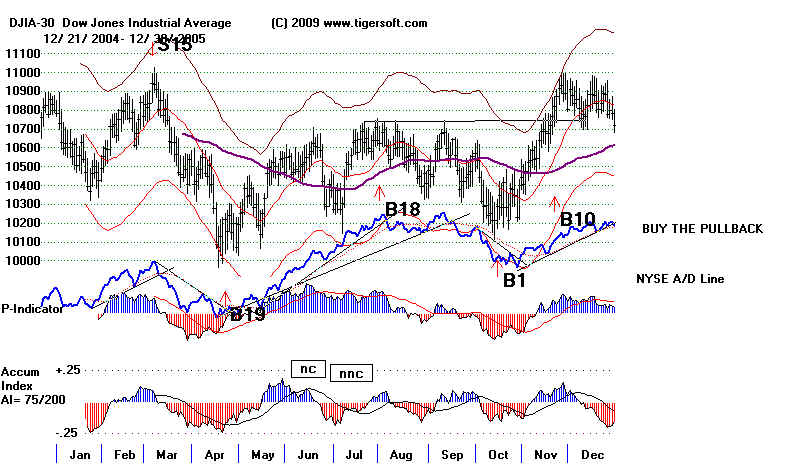
The FED raised the Discount Rate nine times by 1/4%. The stock
market absorned
ese gradual steps quite
well,but the effect for the year was to create a long period of
base-builing that would
prepare the DJI for a successful assault on the all-time high
of the DJI, 11722.98 on
January 14, 2000. At the end of year, the Bush nomination of Ben
Bernanke to replace
Greenspan as Fed Chairman was greeted with enthusiasm by
Wall Street.
Prophetically, after praising him, a Washington
Post editorial wrote:
“...(H)e has never had to manage the response to the default
of a country, the collapse
of the dollar or the
implosion of a big hedge fund, all crises that may lie in his future.”
Katrina
26 October 2005 Unbridled
Capitalist, Bernanke is a “free marketeer”
"President Bush on Monday named Ben S. Bernanke to succeed
Federal Reserve Board Chairman Alan Greenspan, who will step down January 31 after serving
as the Fed chief since 1987. Ben Bernanke, 51, has been an
academic for most of his career, most recently as the head of the Department of Economics
at Princeton University. He was appointed by Bush in 2002 to the Fed’s board of
governors, where he served alongside Greenspan. This past June he was named by Bush to
head the President’s Council on Economic Advisers. He spoke at length praising Bush’s
tax cuts in an October 11 address to the National Economists Club. In an editorial on
Tuesday, the Wall Street Journal wrote, “As for Mr. Bernanke, he supports
making the Bush tax cuts permanent as soon as possible. He’s an ardent free trader,
and we have heard him say favorable things about tax reform.” The response to
Bernanke’s nomination has been highly favorable across the official political
spectrum, as indicated by Tuesday’s editorial in the New York Times
Bernanke was quick
to reassure Wall Street that his appointment would not
signal any significant shift from the policies pursued by the Federal Reserve for the past
18 years. “My first priority will be to maintain continuity with the policies and
policy strategies established during the Greenspan years,” Bernanke told reporters
following the White House announcement.
Stock prices shot up Monday on the news of Bernanke’s nomination for the top Fed
post, with the Dow Jones industrial average rising 169.78 points, or 1.7 percent, the
biggest rally in six months. The appointment is seen by
Wall Street analysts as a sign that there will be no diversion from the economic
principles of the Greenspan era—policies which have led to unprecedented wealth
accumulation for a tiny elite
The appointment comes
at a time of growing nervousness in financial circles over the state of the US and world
economy, and these concerns have been heightened by the prospect of Greenspan’s
retirement. Massive US budget, balance of trade and balance of payments deficits, soaring
oil prices and an upsurge in inflation have roiled the stock market and fueled a sense of
foreboding. These concerns were reflected in an editorial in Tuesday’s Washington
Post which, while praising Bernanke, noted, “...
he has never had to manage the response to the default of a country, the collapse of the
dollar or the implosion of a big hedge fund, all crises that may lie in his future.”
Income
Inequality Will Worsen under Bernanke.
Ultimately
that will bring A Stock Market Disaster, Just As It Did in 1929
"Since 1979, the after-tax income of the top 1 percent of Americans has increased
by 201 percent. The top 20 percent has seen its income grow by 68 percent; the middle 20
percent by 15 percent. By contrast, the after-tax income of the bottom 20 percent has
increased by a mere 9 percent."
Another statistic charts CEO pay at Fortune 100 companies as a multiple of the average
pay of workers at the same firms. In 1980, CEO pay was 41 times that of the average
worker; a decade later it was 85 times greater. By 2000, CEO pay at Fortune 100 companies
was 531 times greater than that of the average worker. This astonishing figure was only
slightly mitigated a year later, to a multiple of 411, as a result of the bursting of the
stock market bubble.
According to the Bureau of Labor Statistics, workers’ average weekly earnings
(measured in 1982 dollars) have gone down in 15 of the 26 years from 1979 through 2004, including a .84
percent drop in 2004.
In 2004, the number
of millionaire households in the US grew to 7.5 million, with this layer controlling $11
trillion in assets. The minimum wage, however, has plummeted in real terms. It is today 26
percent lower than in 1979. Only last week, the US Senate rejected a proposal to raise the
national minimum wage from its current poverty level of $5.15 per hour.