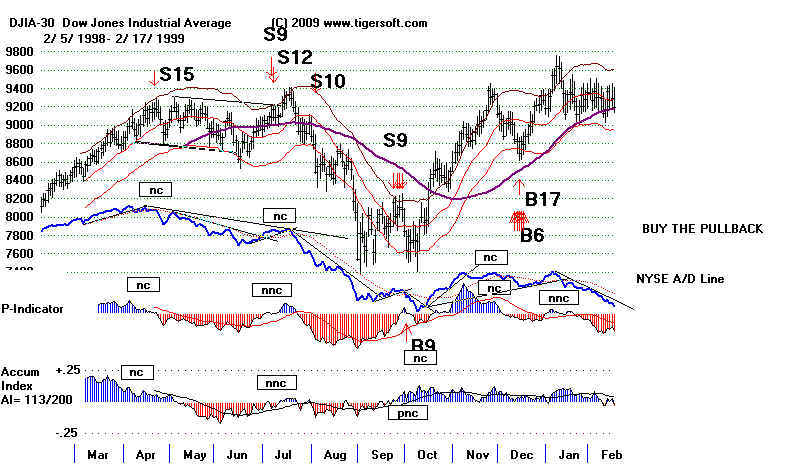
The 1998 mini-bear market was another financial panic. It did not reflect a
slow-down in business or a change in Fed policies in the US. It was the result of over-
unregulated private speculators and over-leveraged foreign financial institutions
elsewhere in the world, all trying to make excessive profits with other people's
money, in a very cut-throat way. It is worth studying, because it shows that
watching Fed policies and economic indicators have their limits. And it shows,
as long as regulations are considered an evil and private hedge funds like that
run by Gorge Soros wield so much power and assume no respobsibility other
than to make bigger and bigger profits, the American stock market will be unstable
and vulnerable to bloody panics and crashes, even though they may not start here.
In this dog-eat-dog world, Peerless is absolutely vital for investment survival.
The market's own statistics when properly interpreted by Peerless do give us ample
warning of such panics. And, very important, you should know that the signals
shown below are essentially the same signals we got back in 1998 real-time.
Here is the Nightline 5-minute video on what it views to be behind the 1998 global
financial panic. It demonstrates that consequences of internationalism and the
internet that made such integration f the world possible. The 1998 Crash is a story of the
rising Dollar, fueled by the Internety Boom in US Stocks, the Asian Tigers that pegged
their country's currencies to the Dollar and G-7 speulators. The rise in the value of
Thai currency made its exports more difficult and aided its imports for those who
had money there. Their balance of payments tilted badly. George Soros was the first
to spot the speculative possiboilities of the situation. He sold short the Thai currency.,
He bet on a Thai devaluation. Other financial speculators followed. It was self-fulfilling.
As the Thai Goverbmebt's financial situation worsened, big bank and hedge fund
speculators joined the attack. In effect, these bankers set out to destroy Thai's finances
to make a profit for themselves. The US Treasury advisors and the International
Monetary Fund were invited in to "help.: That made things worse. The IMF said
Thialand was not a safe place for investments. So many Western banks closed their
doors there This created a still wider panic. On July 2nd, 1997, the Thai government
ran out of cash. In 1998, the the Thai panic spread to Malaysia, Indonesia,
South Korea by end of 1998. Russia and the ruble were soon engulfed.
The "Asian contagion" hurt world commodity prices even more than stocks. Petroleum,
natural gas, metals and timber accounted for 80% of Russian exports. On August
13th the Russian Stock market had ot be closed. It re-opened down 65%. From
January to August 1988, the Russian stock market lost 75% of its value. In 1998,
the rate of Russian inflation was 84%. Russia did recover quickly as oil prices
surged after this. ( Source.)
.