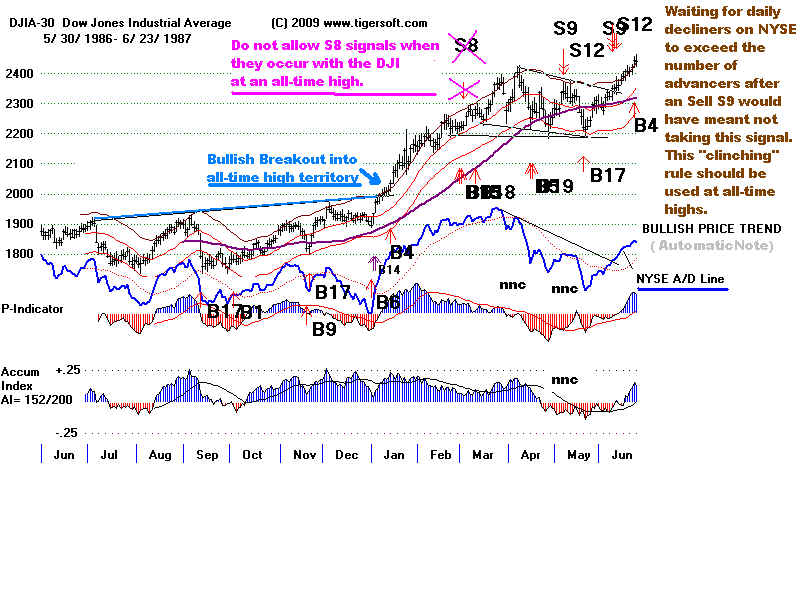
The Bull Market Resumed When DJIA-2000 Is Exceeded
Several lessons emerge from a study of the 1986-1987 chart:
1) Price breakouts past well-tested and well-defined resistance into all-time high territory must
be treated as Buys unless internal strength readings are very negative.
2) Use the clinching rule when the DJI is near an all-time high. The S9/S12 in June
was never "clinched" by a day of negative breadth. Daily decliners on the NYSE did not outnumber
daily advancers before the new Buy B4 overtook the S9/S12 as the effective signal.
3) S8 signals when they occur at all-time highs are not counted. New software can eliminate
older band S8s, but the computer has no way of knowing when the DJI is at an all-time high
in the future.
The Fed did not cut rates after August 1986 in this period. The market's advance
was running on momentum, The NYSE A/D Line began deteriorating as the DJI
staged an irregular (thus, less bullish) consolidation. Market's with so much upward
momentum cannot be stopped easily. Longer lasting bearish breadth divergences
are needed.